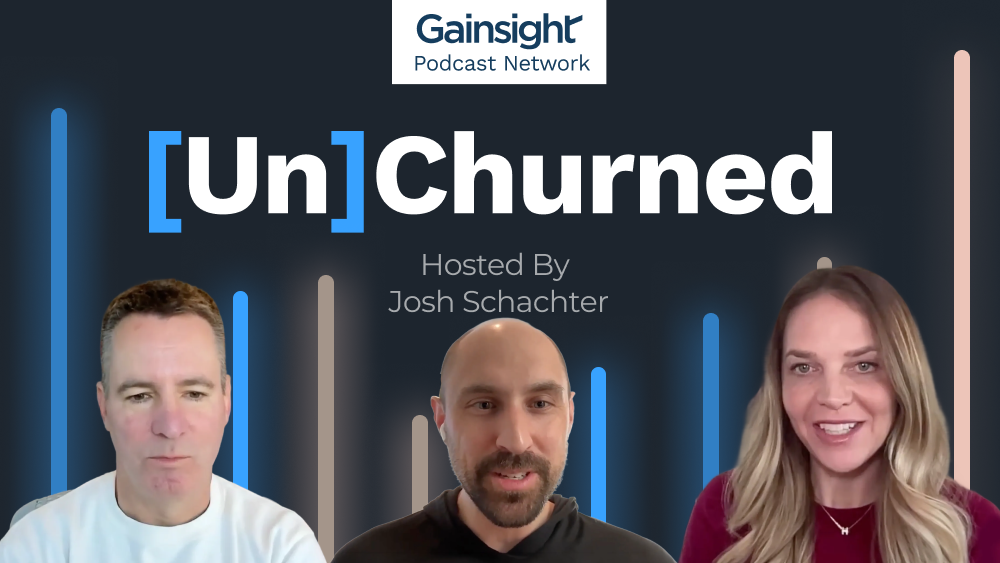
Cassie Vaughn (monday.com) shares how AI, value measurement, and revenue ownership are reshaping the CSM role.

178. How monday.com Turned CSMs Into Revenue Owners ft. Cassie Vaughn (Monday.com)
Show Notes
Join Josh at Pulse 2026 and come say hi—your oversized fluorescent daiquiri is on him. No catch.
Grab your ticket at gainsightpulse.com and use code UNCHURNED for a special rate.
CS is going through an identity crisis.
Is it product? Is it relationships? Is it revenue?
According to Cassie Vaughn (RVP of CS at monday.com)… it’s now all three, and AI is forcing it to be so.
In this episode of Unchurned, Cassie breaks down what’s actually changing inside modern CS orgs after scaling from CSM to leading a 100+ person team—and why most companies are still getting it wrong.
You’ll hear why “value” is still more storytelling than science, why health scores can’t be trusted, and why the future CSM won’t just manage customers… they’ll manage agents.
But here’s the twist: as AI automates more of the work, the human side of Customer Success is becoming even more critical. Monday.com is literally doubling down on time spent with customers—while everyone else is trying to scale it away.
Cassie also shares the bold bet they made: turning CSMs into revenue owners with variable comp—and why, in a consumption world, CS might actually be more commercial than sales.
—
Want the playbook, not just the conversation? Subscribe for deep-dive, actionable breakdowns from every episode at unchurned.substack.com.
—
Timestamps
0:00 – Preview & Introduction
1:10 – Cassie’s journey from being a CSM to RVP
4:15 – What’s changed in CS over the last 6 years
6:13 – Why measuring customer value is still broken
9:35 – Why monday.com doubled time with customers
12:37 – The rise of the “agent manager” CSM
14:07 – Scaling CS with AI vs human touch
16:47 – Why CSMs are more commercial than sales
18:10 – Challenges of shifting to revenue ownership
19:30 – Why CSMs should think commercially & not trust health scores
21:50 – Stop being a generalist: career advice
23:26 – AI fluency as the #1 priority for 2026
25:25 – Lightning round: F1, food, and fun
What You’ll Learn
* Why has no one cracked customer value measurement
* How to build value narratives that actually land with executives
* What AI should automate—and what should stay human
* Why the future CSM is an “agent manager”
* How monday.com is doubling customer time in an AI era
* Why CSMs should be more commercial than sales
* How to introduce variable comp for Customer Success
* Why health scores are not enough (and what to do instead)
Featuring

Josh Schachter, Host
SVP, Strategy & Market Development @ Gainsight

Cassie Vaughn, Guest
RVP of CS @ monday.com
Transcript
Cassie Vaughn:
The CSM is actually more commercial than a lot of the sales functions because consumption and the way that you’re generating revenue is adoption at the end of the day.
And the people who know how to best drive stronger usage or better understanding of how to consume your product are customer success managers.
Josh Schachter [Host]:
You’re listening to Unchurned, brought to you by the Gainsight Podcast Network. Subscribe to our Substack at unchurned.gainsight.com, where we go deep on every episode, like how one post-sales team at CloudBeds built over 150 AI agents. That story and more at unchurned.gainsight.com. Hey everybody, and welcome to this week’s episode of Unchurned. I’m Josh Schachter, Senior Vice President of Strategy and Market Development at Gainsight, and I’m super excited to be here this week with Cassie Vaughn. Cassie is the Regional Vice President of Customer Success at monday.com. Cassie, thank you so much for being here.
Cassie Vaughn:
Thanks for having me, Josh.
Josh Schachter [Host]:
And it’s such a treat to actually be in the flesh, in person. It’s rare. Yes, it’s very rare these days in the remote world that we’re in, but only for our VIPs. So we’re happy to have you here.
Cassie Vaughn:
Thank you. I’ll take it.
Josh Schachter [Host]:
Yeah, yeah. Okay, so RVP, Regional Vice President at monday.com. You’ve been there for like 6 or so years.
Cassie Vaughn:
6 years, yeah.
Josh Schachter [Host]:
Okay.
Cassie Vaughn:
Almost 6 years.
Josh Schachter [Host]:
And you’ve come up through the tracks there. Like you started out as a CSM and now you’re running 100+ people.
Cassie Vaughn:
Is that right? Yeah, yeah. It feels like a dream, honestly, when I— explain this to people, it doesn’t feel, it feels like I got my moonshot opportunity that I never could have predicted. But it is really a case of right place, right time. And, you know, I think these days the way that you see it, it manifests much more quickly just because roles are being invented and organizations are growing as fast as they are. But the way that it was at Monday, I just took a shot on the right company and, and here we are.
Josh Schachter [Host]:
Well, okay, so it’s right place, right time, but I also believe that you create your own luck. So I’ll call bullshit on some of that.
Cassie Vaughn:
No, I’m a big believer in manifestation, so I fully agree.
Josh Schachter [Host]:
No, no, no. Not even manifestation. Like, you actually, like, work hard and have intention.
Cassie Vaughn:
Like, you know, equity.
Josh Schachter [Host]:
Yes. What equity adds up to something? Hope. We hope so, right? Yeah. Most of the time. And I happen to know that you’re, you know, you built your own path there because I’m friends with Tom Ronan. Tom is now the VP of CS at Harvey AI, and he was like numero uno at Money.com in post-sales, right? Great guy. Also a New Yorker like us. Yes.
Josh Schachter [Host]:
And I texted him this morning. I’m like, Tom, I’m gonna be speaking to Cassie today on the show. So tell me something about her that I can shock and awe her with. But Tom is a nice guy. He’s not gonna say anything too sensational.
Cassie Vaughn:
No interesting photos, yeah.
Josh Schachter [Host]:
No, no photos?
Cassie Vaughn:
Yeah.
Josh Schachter [Host]:
What photos should he send?
Cassie Vaughn:
We have a lot of blackmail over the years.
Josh Schachter [Host]:
Oh, that’s for the next episode. Cassie, I mean, a lot of this is just factual, whatever. Cassie went from CSM to RVP. Managing 100 people-ish, lots of ARR, and she managed to excel throughout the way at every little thing she did. She’s a star. Anyway, he says, and then you can tell the rest was cultivated through ChatGPT, but emotional intelligence, you’re highly emotionally intelligent. Managing through change, you’ve seen a lot of change and you managed really well through that. Commercial rigor for CSMs.
Josh Schachter [Host]:
You have gotten CSMs to operate like AMs, including renewal forecasting. And we can talk a little bit about like how to incentivize folks. I was just talking— I won’t call out names, but I was just talking to a CRO at a very well-known up-and-coming AI platform just yesterday. And this person is building their go-to-market from like, like 20 people to like 300 people over the next year. And they are gonna be putting in AMs but no CSMs.
Cassie Vaughn:
Interesting.
Josh Schachter [Host]:
Yeah, interesting, right? So we can talk a little bit about that, that sort of thing. And then he also said that you oversaw a lot of CSMs, I mean, including yourself, who were promoted to management. And it could be interesting to get your take on coaching first-time leaders.
Cassie Vaughn:
Wow, this is a nice way to start. I feel like it’s like a performance review, but—
Josh Schachter [Host]:
The other text message where he gave the areas for improvement, that’ll come up later. Yeah, exactly. So let’s talk about a little bit, you started as a CSM at Monday.
Cassie Vaughn:
Yes.
Josh Schachter [Host]:
You’ve worked your way up now to managing a large team, lots of responsibility. What has changed, not for you, that’s kind of obvious, but what has changed in CS that you’ve observed during your time?
Cassie Vaughn:
Everything has changed in CS. So what I tell candidates when they’re interviewing is that Monday has really gone through 3 iterations of the CSM role, and I think it matches what the market has seen. It started as being an evolution of like a breakoff from CX or an evolution of onboarding, onboarding 2.0, and then suddenly you take it through the full customer life cycle. And back then everything was about health score, everything was about, you know, how do we drive adoption? And that was the north star that we were shooting for. And it was very much product focused. So your value that you could bring to customers was your knowledge of the product and your ability to connect them to that. The second iteration was us starting to move in the direction of making them more commercially minded. And this is where I, when I was at LinkedIn, I started as in the customer success function and then I moved to the sales function and I saw that there was such a natural overlap there.
Cassie Vaughn:
There was no reason to need to separate forecasting and doing some of this retention driving behavior from the CSM role. So the second iteration was focusing on two more commercial elements. One was relationship building. So how do you build relationships with executives? How are you getting to the more influential people within the customer? And then two was that forecasting mindset. So how am I predicting risk, not just to call it out, but for the sake of tracking the impact on revenue, and then explaining that to the business. And then the third iteration came where we almost swung the pendulum too far in the relational direction and we lost the focus on the core of being technically minded and technically savvy and product experts first. And Monday at the same time became a multi-product company, started to shift away from being PLG, and then we had to put everything into the context of value for our customers. And that’s kind of where we still are, but Moving on to iteration number 4, and that is a balance between being the relational value connector, being the technically minded savvy product expert, but now we have to move forward into the age of AI and it’s a totally different ballgame.
Josh Schachter [Host]:
I’ve heard a lot from folks around value architecture.
Cassie Vaughn:
Yes.
Josh Schachter [Host]:
Everything’s outcome-driven now through Agentic that makes it easier to be that way. Sounds like that’s where you are with the team right now, making them the value architects.
Cassie Vaughn:
Yes, that’s where we’re going. We’re there in terms of being able to do value narratives and value delivery, the challenge is one, it comes down to how you actually measure value and how you actually measure outcomes. And I don’t think it’s one that anyone has a good answer to. I can think maybe of like LinkedIn. When I worked at LinkedIn, it was very easy to say, if you use the recruiter product and you get an answer to this in-mail and then they get hired, right? You can connect to that outcome. Most companies can’t do that. Like maybe CRMs, maybe like the product I just mentioned, but genuinely connecting to the outcomes of a customer, it’s a lot of it is trust and a lot of it is how do you build that narrative for them to understand how what your product does and the service that you’re offering is actually connected there. That attachment doesn’t exist without a human being able to do that.
Josh Schachter [Host]:
Well, I mean, a lot of folks use you guys for, for CRM, right, to kind of create their own. But it’s like more of a horizontal platform. You can do anything with that.
Cassie Vaughn:
Definitely.
Josh Schachter [Host]:
Exactly. Which is probably a blessing and a curse.
Cassie Vaughn:
Yes.
Josh Schachter [Host]:
Like you’re saying, double-edged sword. Yes, double-edged sword for value, for the value equation. So how do you calculate value?
Cassie Vaughn:
Yeah, great question. So it’s something that we’re iterating on right now, and it’s something that I think we need to co-build with customers in a very custom way. What we originally tried to do was anchor to value statements that were true across as many of our customers as possible, like productivity, time savings, cost savings. But even that, there was a bit of a leap to get there, and we had to coach them to believe in that.
Josh Schachter [Host]:
Well, ’cause time savings is tough.
Cassie Vaughn:
It’s tough.
Josh Schachter [Host]:
That’s tough to measure in.
Cassie Vaughn:
Yeah. And we would say things like, you know, every automation is the equivalent of 2 minutes back, but It’s a stretch and it’s a guess at its best. And some people loved it, by the way. Like some executives, they had no better way to measure it. So they’re like, thank you for providing me this framework. Others were rightfully so questioning the logic there. So now instead, everything becomes about use cases. So we have to pick the specific use cases where we know that the objectives are clear.
Cassie Vaughn:
The objectives are actually things that are driving real revenue for the business and are mission critical to the business. And we can directly connect and attach Monday to this. But I don’t think it’s even a Monday problem. I was at the SaaS conference 3 years ago and there was a panel of CS leaders from like some of the hottest names in CS were up there, and I won’t name names, but they were talking about this topic and all of them had their way of saying, yeah, and we know that our product connects to value and outcomes. And I asked the question like, how? Like, where is the attachment? How are you making that attachment? And there were no good answers. And even still, when I’m asking other CS leaders, we’re getting closer, but everything is very custom. There is no silver bullet answer.
Josh Schachter [Host]:
There’s no silver bullet. Even for Gainsay, I mean, we know our place. We know that we’re helping to increase, you know, GRR and NRR and those outcomes. But those things are multi-attribution and they’re tough to have a very direct, like, this is the single causation for that metric. That’s why sales is so easy. Oh my God, to be in sales, be like, yeah, great, I converted the deal, done, right? Like sales cycle velocity, like it decreased, great, or increased.
Cassie Vaughn:
It’s one of the few true metrics that you can track. But yeah, everything else is, it’s storytelling at the end of the day. It’s how you get them to believe that this is the outcome that you’re helping them achieve.
Josh Schachter [Host]:
Okay, so storytelling.
Cassie Vaughn:
Yeah.
Josh Schachter [Host]:
Which sounds like value narratives. You mentioned that before. That’s also something that I’ve heard a lot from other leaders that have been on the show. And Sophia Barbosa, she’s, she’s the CCO at BMC. She talks a lot about her. She’s identified her value narrative process. Actually, at Gainsight, I’m working on a transformation for us to identify our instance reviews, which is kind of a form of our value narrative. What are you doing in that sense at Monday?
Cassie Vaughn:
Yeah, so on the agent front or on the value narrative front?
Josh Schachter [Host]:
I don’t know, whatever you want to talk about.
Cassie Vaughn:
So let’s take it to, let’s go on the agent front. So I actually think that value narratives are one of the few things I don’t want agents to own. I think they can pressure test them, but at the end of the day, like I said, for us to understand the value for the customer, it’s a human connection. We have to be able to align on that through various conversations with executives, through pressure testing, through actually seeing how the workflows manifest and seeing their work day to day. Yeah. And that actually comes more from more human time spent. So the way that we’re driving understanding value, and then I’ll get to the agent piece, is this year we committed our CSMs to spending actually double the amount of time that we have spent with customers in the past. And it’s something that we wanted to invest in because Monday made retention one of the true north metrics for this year.
Cassie Vaughn:
It’s something we’re hyper-focused on. And in order to drive retention—
Josh Schachter [Host]:
Like every company.
Cassie Vaughn:
Like every company, like every company. But this year it felt different because Monday was still and is still very much in a period of very quick growth. So to make retention, to give it an equal platform, even a higher platform and a bigger spotlight, I think is actually kind of rare for where we are in this stage. But how we are getting there is more of a human touch in the high-touch segment. There are obviously things that we’re doing in more of the medium-touch space that is agentified. But where I want my CSMs to spend time there is being on site or being hands-on with the customers and have them actually do the architecture mapping for you. So the full workflow or the full process that they’re trying to solve, the full problem, visually map it out from A to Z.
Josh Schachter [Host]:
Have your CSMs do that, or have the customer do it, or together?
Cassie Vaughn:
Both, together. Whiteboard it. Like, this is what I have in my mind.
Josh Schachter [Host]:
And you’ve got a lot— well, OK, in your mind. Oh, so this is all vaporware now.
Cassie Vaughn:
No, no, no. It’s there. But I’m saying, like, when I’m speaking to this out loud, it’s done on a whiteboard. It’s on a canvas.
Josh Schachter [Host]:
But you’re encouraging your folks to go and to be in person for the larger accounts, obviously.
Cassie Vaughn:
Yeah, definitely. And even not for the larger accounts, I think that the human connection is still so much where the CSM is needed. And the human connection is still very personal and face-to-face. So what we are looking for them to do is do a full process mapping exercise and understand the process as it is without just like the Monday touch on it. So what are the problems? Where do they generate from? What are the teams that touch this? And then at the end of the day, what are the outcomes you’re trying to drive? Then we take a step back and we actually look and say, which of these things do we think 1 to 2 years from now is not going to exist anymore and not be part of the process because of AI, because of tech replacement? How do we make sure that what we’re building and what we’re remodeling for this customer right now is not factoring in those elements and is actually skipping ahead a step. So how can we coach our customers to get there and to start thinking that way? And a lot of that comes from the fact that the largest percent of our customer base is not from tech. So where we are living in the world of AI and everything is about AI, many of our customers aren’t even there yet or they’re just starting to get there. So there’s a lot that we can do to also help with driving them in that direction and being the partner that leads them there.
Josh Schachter [Host]:
It goes back maybe to the double-edged sword, like your software can do so much, so you have to boil the ocean a little bit with them, like prioritize the use cases. And then maybe that’s part of a land expand opportunity for you, expansion in terms of the use cases, right?
Cassie Vaughn:
Yeah, yeah, definitely. But I think the more interesting thing is on the other side, which is the agentic route. So the value pitch and the value narrative is not something that I want to touch there because I do think that that’s the piece that we can bring that human element. What I do want to see is all of the playbooks that we’ve developed for customer success. If it’s a playbook, if it’s a framework, if it’s something that’s repeatable, it can be done by an agent. You can pretty easily train an agent to do these things. So instead it’s, it’s shifting the role of the CSM to think about being an agent manager. So how do you call the right agents at the right time? How do you make it so that you don’t even have to be the one to deploy the agent? In a lot of cases, based on certain customer interactions, the agents will know to deploy certain elements of what they can do.
Cassie Vaughn:
And then from there, it’s using the CSMs for the things that are the most critical, which is judgment calls, relationship building. Like, here’s the real human factor in how we can move the needle. But the agent management is still a skill that we have to train. Like once agents are there, it doesn’t mean that they just run on their own. That’s a new motion that I think CSMs are uniquely equipped to be able to take on.
Josh Schachter [Host]:
Are you guys currently taking this on or this is in planning for this year?
Cassie Vaughn:
Yeah, we are currently taking this on.
Josh Schachter [Host]:
Join me at Pulse this May in Las Vegas. I’d love to meet our listeners. Come say hi and your daiquiri in that tall fluorescent cup is on me. Seriously. Use code UNCHURNED for a special rate at gainsightpulse.com. How do you deputize a team of 100 CSMs? For CSMs to start all using agents and to do it in an effective way?
Cassie Vaughn:
Yeah, it’s a good question. So our approach is this. We’ve segmented our customer base into a high-touch motion, which is where my team sits. And then we also have a medium-touch motion where it used to be what scale CS was. And most customers or most organizations still have some element of scale CS, but now we’re just using a tech team to actually provide the value there. And the tech-touch motion is one where we’re creating various agents to do. So for example, there’s a couple of things that our agents are being set up to do today. They can do some basic discovery, so they can capture the information for you, collect it, synthesize it, give you the output of what the customer wants.
Cassie Vaughn:
They can do optimization, so they can recommend within the product, okay, based on what you’re telling me, I think this is what you want to do. Do you want me to actually go and change that part of your workflow for you? They can also build from scratch. So all of these things are things that used to take hours of time for the CSMs. And in a lot of cases, we still want them there for certain scenarios, But if you want to think about how you scale, how you work with some of these larger customers where we have hundreds of thousands of users, you have these agents working with most of those end users at the end of the day. And you’re spending your time with the people who need to better understand the value that they’re getting from these agents working with their people. And that’s where the storytelling and the human component comes in.
Josh Schachter [Host]:
Are you using your own systems for the agents or what tools are you using?
Cassie Vaughn:
It’s a good question. So I think Monday, we’re very lucky because we’re so primed and ready for AI usage. We have our own agents that we sell. We also have Monday Vibe, which is a vibe coding tool that we sell. So we’re selling a lot of the things that we can also use.
Josh Schachter [Host]:
I didn’t know there was Monday Vibe.
Cassie Vaughn:
Oh yeah, you’ve got to start using it.
Josh Schachter [Host]:
Oh wow. Okay, I need to start getting with that.
Cassie Vaughn:
Yeah, it’s amazing. So there’s two, there’s really two challenges here. One is how do you bring AI internally to your CS organization? And then how do you sell AI and equip your customers? And they’re actually two very different challenges. But what I’m finding is that the CSM, the role of the CSM, I think the way that it’s shifting, the value and what you’ll look for in a CSM is actually someone who’s a domain expert. Expert who can speak and understand the objectives in a real way with these customers and has done it and delivered it before. But the other thing that can create domain expertise for CSMs is being the ones who are managing agents so that when you’re going and selling agents or selling a vibe coding tool to your customers, you’re also living in it, you know it. So we’re trying to solve both, but in two very different ways. The way that we’re bringing in internally, I think is for me the more interesting one first, because we have to build the awareness and the understanding of these AI tools before we can go and preach them and try to be consultants to our customer base.
Josh Schachter [Host]:
You need to drink your own champagne. Yeah, same thing with us at Gainsight, right? We all need to be leaning in and AI first and before we can actually be the consultants and the coaches and the guides of the market. Let’s go back to the commercial bit.
Cassie Vaughn:
Sure.
Josh Schachter [Host]:
So how commercial should CSMs be?
Cassie Vaughn:
Yeah, it’s a good question. I think in the age of AI, and this might be contradictory to the unnamed CRO that you were just mentioning, but Especially as we’re moving to a consumption-based, a lot of companies are moving to consumption-based pricing. I think the CSM is actually more commercial than a lot of the sales functions because consumption and the way that you’re generating revenue is adoption at the end of the day. And the people who know how to best drive stronger usage or better understanding of how to consume your product are customer success managers. So we took a big bet on that this year. We changed our compensation model to being one where our CSMs are now they have variable compensation on both retention and growth. So that was to maintain the alignment with our account management counterparts. But the retention piece I think is one that is crucial.
Cassie Vaughn:
If you want to say that you, I think a lot of customer success organizations right now are trying to prove their value in the way that they influence revenue. If you want to say that you influence revenue, you have to put your money where your mouth is. So be willing to take on a stake in the game. And then on the other side, it’s a great, motivator for the CSMs who are doing fantastic work, but maybe don’t get to ring the gong when the deal is closed. But now they’re getting paid if they’re bringing in and retaining more of that revenue.
Josh Schachter [Host]:
So if I’m a CS leader listening to this, I’m like, oh, that’s awesome. I would love my company to do that. But like, it sounds exhausting to try to make that push for, for those incentives. Real talk. What were the headwinds that you faced? Like, how did you, how did you guys create that new protocol for them?
Cassie Vaughn:
So it’s for Monday, it’s even double the headwinds because we as a company did not have variable compensation compensation models even for our sellers for a very long time. It was something deeply in our culture. We didn’t believe that, we thought the best sellers were the people who loved the product the most and would go out there and continue to push Monday without needing the cash incentive there. I’m oversimplifying it, but it worked for a very long time. And keep in mind, we were PLG and we still are in a large degree PLG. So we were looking for a different type of seller. Now we’ve shifted. So the sales team was the first to take on the variable compensation model.
Cassie Vaughn:
CS was fast follow. Because we jumped onto a moving ship, it was much easier. But even then we had to get a lot of buy-in for additional revenue to come this way or additional funds to come this way, new operational flows and new operational systems. When it became abundantly clear that especially crossing the billion-dollar threshold for our company, we were going to start generating more revenue from our existing customers and we had to make retention such a top focus, it was a no-brainer then to pay the CSMs. You want to know that these people are locked in, not just on adoption driving, not just on use case identification, but on what truly matters at the end of the day, which is helping continue to drive the revenue of the business.
Josh Schachter [Host]:
Now, according to Tom and according to deep research in the LLMs, you’re known for your coaching of CSMs. What type of coaching has, or has that taken any type of coaching from you to your team around how to be more commercially minded?
Cassie Vaughn:
Yeah, definitely. So I think in a couple of ways. One, the motion of forecasting is something that we brought in 3 or 4 years ago, and that to me is, the heart of the commercial mindset because you have to be able to tie what you’re seeing with the customer to a dollar value. So we’ve owned the renewal forecast and we still do for years now. And in calling that forecast, it took us—
Josh Schachter [Host]:
Is that a hot take? Is that usually something that’s—
Cassie Vaughn:
I haven’t seen it elsewhere. I think it’s mostly owned by account management teams, especially if they have a retention outcome. And now our account managers will move to owning it. But we— it was a gap for us because nobody was being paid on retention outcomes at Monday. So We decided if anyone’s going to know how to be able to forecast this, it’s going to be us. But just driving the notion of having to ask someone to call a number, even if they’re not being paid on it, there’s some pressure there, right? Like they’re making a bet essentially. And you’re then judging their ability to assess risk and to assess opportunity. And that’s—
Josh Schachter [Host]:
Putting themselves out there.
Cassie Vaughn:
Exactly.
Josh Schachter [Host]:
And throwing out a number.
Cassie Vaughn:
Yeah, putting some stake in the game.
Josh Schachter [Host]:
So is there a different type of mindset? Are there softer skills that need to be shaped?
Cassie Vaughn:
Yes, it’s a lot of it is what I call like detective work. So the reason why I don’t like health scores and I don’t trust them is because people rely on them too much. And at the end of the day, it’s a number and there’s so much that doesn’t go into that from what you’re hearing in conversations, etc. So what we had to train them on was look beyond what the data is telling you, like don’t take this at face value, go in and ask harder questions. If you’re getting a weird gut feeling, like even at that level, your gut, if you’re feeling that this customer is telling you something, but then they’re not actually super responsive, they’re not engaged, they’re not fully bringing to life what you had committed to, there’s more that you need to investigate, get in there. So it’s more the detective work that comes into it. But I think at the end of the day, also getting them to think about like, how does this then lead to commercial strategy? So would we change our pricing offering based off of certain things or the services that we’re able to offer? What can we bring in here to actually substantiate them keeping this baseline? And maintaining the revenue for each individual customer, that also feeds into the, into the mindset of being more commercial and, and coming in and being able to own something like a quota. Yeah.
Josh Schachter [Host]:
What other tips for CSMs that want to follow in your footsteps and want to keep on climbing the ladder?
Cassie Vaughn:
I think it’s, for me, it’s all about how you experiment. Like you, the new job description for a CSM and how I’m thinking about hiring CSMs in the future isn’t actually a CSM. It’s someone who, one, again, comes with deep domain expertise. So stop being a generalist and specialize in something. Like learn an industry, learn a function, learn a use case deeply to its core. And then on top of that, it’s the self-starters.
Josh Schachter [Host]:
Says the CS leader of the kind of more horizontal type of product.
Cassie Vaughn:
I know. So we have to get there. And this is something that we have to hold ourselves accountable to as well. And getting into industry expertise and picking the ones that are our bets That’s going to be part of this as we move forward. But beyond that, it’s also the way that you come up through the ranks now. And this isn’t specific to CS. You can’t rely on mentorship. You can’t read books.
Cassie Vaughn:
You can’t take courses. Everything becomes antiquated in 30 days.
Josh Schachter [Host]:
Okay.
Cassie Vaughn:
The amount of time it takes to even publish a book, you’re— by the time it’s published, it’s, it’s old. So we have to be finding people who are willing to invest in their own self-development, taking in short-form content, listening to podcasts, going on X, going on, you know, TikTok even, and, and learning about these changes in AI and the new tools and the way that they should be used and integrated, and then take a risk. Just because the company doesn’t have it in its tech stack doesn’t mean you can’t go create your own, you know, account out there on some of these AI platforms and start to experiment. That’s really the mindset that I’m looking for. Less than the playbook CSM who knows how to follow a risk through and create a success plan. Like those are all things that AI will be able to do. It’s more the self-starter and the domain expert that we’re gonna see.
Josh Schachter [Host]:
What are your big rocks for 2026?
Cassie Vaughn:
Yeah, I think one of my big rocks is this AI fluency. How do we drive people to create such an innate curiosity themselves that it doesn’t come from within? Like, you don’t have to wait for a leader to prompt you or for someone to tell you we’re now going to do AI training. It’s the, the mindset that you don’t feel comfortable even getting in front of your customers without knowing some of these things and being well-versed enough to have an opinion on AI, even if you’re not selling it, even if you’re not using it yourself. You’re going to lose trust very quickly. So the big rock for me is AI fluency, or at least AI exposure and experimentation for people to be able to start speaking this language to our customers. It’s one, going to be the motion that helps us find the people who will be the accelerators for the organization. So the catalysts for the new workflows that we’re creating, the people who will find the new innovative way to do XYZ. But then also, again, like I said, when I’m putting them in front of an executive, And some of these executives are not within tech.
Cassie Vaughn:
Even listening to a couple of these conversations and staying in tune with the shifts and the trends can equip you so much to help them feel comfortable that you know if you’re giving them a recommendation, you know where you’re leading them and you know what the future looks like with these new systems and with these new models. So that I think is my big rock is AI fluency. And then the second one is moving towards this more commercially minded revenue structure for us. It’s one that the change is still very much in process. We haven’t come up on the first quarter yet. So this will be the first quarter that we’re paid in this way at the end of Q1. And that’s where we’re going to start to see some of the friction, some of the opportunity. But again, I think what I’ve learned in this leadership realm is that being accessible and being there in the field with them, them seeing how this is impacting my paycheck, and I call this out all the time, I’m like, listen guys, the reason I care about this risk is because I’m also getting paid on it.
Cassie Vaughn:
They feel like we’re in it with them. They’re going to learn that eventually while they’re the ones who have to stick their neck out on the line and call the number, everyone’s there to support them.
Josh Schachter [Host]:
Makes sense. I think we got there to the finish line. So which leads me to my two lightning questions for you here, personal questions. You’re an F1 fan.
Cassie Vaughn:
Oh, wow. Yeah, huge F1 fan.
Josh Schachter [Host]:
How’d you become such a big F1 fan?
Cassie Vaughn:
I hate to say this, but I was one of the COVID people who watched Drive to Survive, but then I took it to the next level. Like, I really started to invest in learning how the cars were built, and my husband and I got into F1 strategy. We’ve gone to a few races now. It was off of, I mean, I—
Josh Schachter [Host]:
I mean, wait, sorry, isn’t the F1 strategy like go fast and don’t die?
Cassie Vaughn:
No, it’s way more than that, which this is the shocking part. It’s very scientific. There’s so much physics behind it. I mean, I can’t explain any of it, but even the strategy around a pit stop, you would never guess how much goes into that.
Josh Schachter [Host]:
It’s incredible. I started watching the show actually recently. I’m not a COVID watcher, but like, what is it, like 5 seconds?
Cassie Vaughn:
Not even, 2.
Josh Schachter [Host]:
Insane.
Cassie Vaughn:
Yeah, it’s insane. So I use a lot of F1 metaphors. I think it’s actually a great, now that so many people have gotten into the sport, especially in the US, There’s so many things that you can tie to those stories.
Josh Schachter [Host]:
Favorite driver?
Cassie Vaughn:
Lando Norris. But I was not a bandwagon Lando fan. I was a Lando fan from like his first season driving in F1. So I feel like I can claim that.
Josh Schachter [Host]:
Oh, was he like the hot up-and-comer?
Cassie Vaughn:
He was just the world champion.
Josh Schachter [Host]:
Yeah. Oh, he was just the world champion this year?
Cassie Vaughn:
Yeah, last year.
Josh Schachter [Host]:
Oh, okay.
Cassie Vaughn:
So he was an up-and-comer and then he made it. So yeah, it’s a good story, but one that—
Josh Schachter [Host]:
I’m a few seasons behind in Drive to Survive.
Cassie Vaughn:
I can see you’ve got to catch up now. The new season’s actually coming out this week. So there’s the pitch.
Josh Schachter [Host]:
Oh, wow. What do you know? Okay. You’re also a foodie.
Cassie Vaughn:
Yeah, I am a foodie.
Josh Schachter [Host]:
Favorite New York restaurant?
Cassie Vaughn:
Okay. So I have to say Kiki’s. I’m Greek and I think Kiki’s is like still, I know it’s been overdone now, but it’s my favorite taverna-style food. Lower East Side, Chinatown even. I don’t know if you’ve been, but amazing food. And also like low frills. Like you don’t have to wait forever to get a reservation. It’s just like a chill spot, very close to Times Square now where there’s a number of bars popping up.
Cassie Vaughn:
So highly recommend.
Josh Schachter [Host]:
Cool. Awesome. Well, Cassie, thank you so much for joining us. This was a pleasure, a real treat. Love what you’re doing with the team at Monday. And, um, yeah, wishing you more of all the best in 2026.
Cassie Vaughn:
Thanks so much, Josh.
[Un]Churned is the no. 1 podcast for customer retention. Hosted by Josh Schachter, each episode dives into post-sales strategy and how to lead in the agentic era.
Browse Series
Subscribe on