
Churn doesn’t usually come with a warning. When a customer skips a QBR, stops responding on Slack, or sends the dreaded “we’re evaluating our options” email, their decision is often already set. The signs showed up months before, but you missed them.
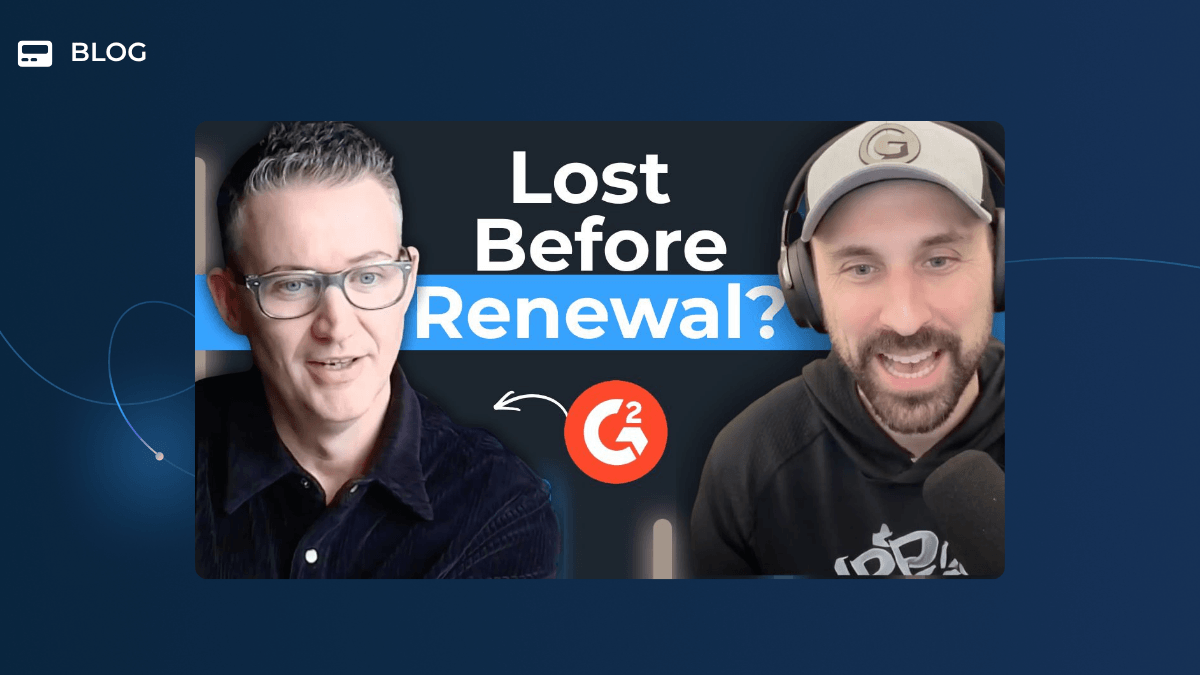
Eric Gilpin, President of Go-To-Market at G2, has spent 25 years building two-sided marketplaces at CareerBuilder, Upwork, and now G2, where almost 200 million buyers choose software each year. On a recent episode of [Un]Churned, he explained how G2 changed its approach to buyer intent data and, as a result, created one of the most proactive churn-prevention systems in B2B SaaS.
The idea sounds simple, but putting it into practice is much harder.
Buyer Intent and Churn Intent Are the Same Signal
G2’s main product lets revenue teams see who is actively researching software in their category. When a company looks at competitors, compares pricing, or reads reviews, that’s a buyer signal. G2 sells this information to help software companies find and win new customers.
Eric’s insight was that the same signal works in reverse.
“We kind of flipped buyer intent into what I call churn intent,” he explained on the show. When one of your current customers starts doing those same things, like visiting competitor profiles, reading comparison pages, or looking at other products in your category, that’s not a new lead. That’s a customer who is rethinking their choice.
G2 added this process to their own retention workflow. Their Slack integration alerts account owners right away when a customer is shopping on the platform. Customer Success Managers (CSMs) and account managers can see which accounts are at risk and what those customers are viewing, often months before renewal talks begin.
Timing is what makes this so important. As Eric said, “Retention is a lifecycle. They didn’t churn 90 days before the renewal. They churned three days after they bought it.” To prevent churn, you need to spot the signals early, not rush to fix things when the contract is almost up.
Be Your Own “Customer Zero”
You can only build a churn intent system if your team is deeply involved with your own product. Eric calls this being “customer zero”—using your platform just like your customers, understanding its value from the inside, and bringing that knowledge into your post-sales process.
For CS leaders, this is an important standard. It means your team uses the same data your customers use to guide their actions. This lets you have conversations based on real signals, not just gut feelings.
Being customer zero also means taking a closer look at onboarding and integration. Eric pointed out that buyer intent data is only useful when it connects to the tools your team uses, like your CRM, CS platform, or marketing automation tools. Setting this up early in the customer journey is what helps customers see value instead of quietly leaving.
The Post-Sales Model Built for Expansion
G2 uses what Eric calls a “Hunter Hunter” model for post-sales. Account managers are responsible for expansion, with targets based on both retention and new growth within current accounts. Customer Success (CS) focuses on product adoption and integration depth, making sure customers get real value from the data, not just pay for access.
The numbers reflect why this matters: more than 60% of G2’s gross bookings come from existing customers. That figure shapes every org design decision.
For the 150,000+ smaller products on the platform, G2 is using AI-driven automation to stay proactive at scale. For example, the system can alert a customer if their review recency has dropped in the past 90 days and their grid ranking is at risk. This outcome-based engagement doesn’t need a CSM to step in, but it still adds value. It also lets the human team focus on areas where their judgment and relationships make a real difference.
The AEO Bet That Paid Off
Eric says any conversation with him is bound to include how G2 is approaching the shift from search engines to answer engines. When ChatGPT launched in late 2022, G2’s leaders made a bold choice that not everyone agreed with: they opened their data to LLMs. Any model could train on G2’s public reviews.
The decision was based on two beliefs the founding team held. First, the future always wins over the business model. Second, dollars follow eyeballs, and people were moving toward AI-powered answer engines.
Fast forward to today, and G2 is a top-10 cited website across major LLMs. Overall traffic is up 31% year over year. Competitors who locked their data down are now paying the price for it.
For CS and revenue leaders, the lesson goes beyond data licensing. Eric describes this as a willingness to challenge your own status quo before someone else does. The companies that succeed during disruption aren’t the ones who protect what’s working. They’re the ones who prepared for what was coming.
As Eric said on the show: “Nostalgia and denial kill businesses.”
What CS Leaders Can Take From This
The main point Eric made is that retention is about intelligence before it’s about relationships. Even the best CSM can lose an account if you don’t spot the right signals early.
A few questions worth asking about your own post-sales motion:
- Are you collecting the right signals? Product health scores are important, but they don’t tell the whole story. Behavioral signals, support patterns, engagement trends, and, if you have it, third-party intent data should all help you assess risk.
- Is your team using your own product deeply enough? Being “customer zero” shapes how your team diagnoses problems and has conversations.
- Is your approach to expansion proactive or reactive? If account managers only focus on renewals, you’re missing out on growth. Whitespace mapping and product-line expansion require a dedicated process, not just an annual conversation.
- Are you also planning for scale? High-touch relationships can’t reach every account. AI-driven engagement for your long-tail customers isn’t just a compromise; it’s necessary.
Customers who are about to churn are already sending signals. The real question is whether you have the systems in place to notice them.
Stay Ahead of Every Renewal
This conversation is part of [Un]Churned, the number one podcast for CS and revenue leaders navigating retention, expansion, and the agentic era. New episodes drop every week.
Listen to Eric’s full episode here.
For deeper dives into every episode—including the playbooks, frameworks, and tactical breakdowns that don’t make it into the show notes—subscribe to the [Un]Churned Substack.
