Gainsight vs. Planhat:
Which CSP Is Right For Your CS Team?
Gainsight and Planhat both support core CS workflows, but their strengths show up in different ways. See how each platform supports visibility, execution, and growth—and which one fits your team’s goals best.









How Gainsight and Planhat Compare
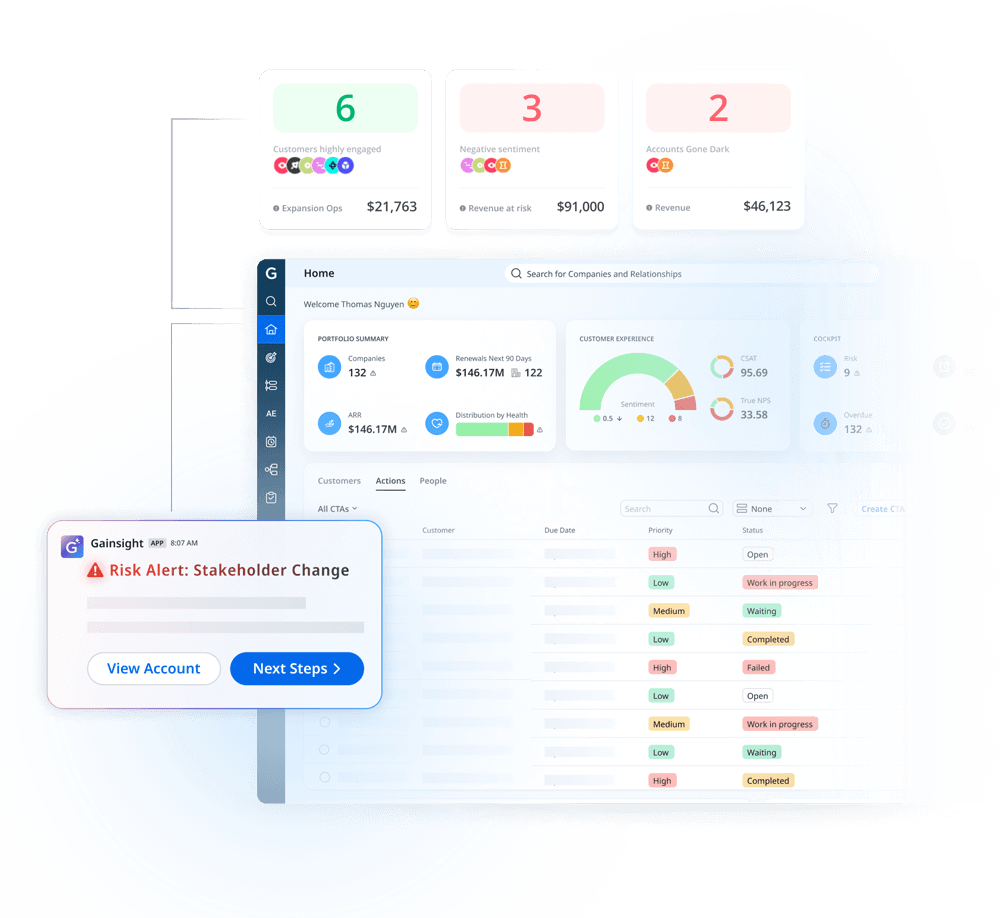
Gainsight is built for CS teams that need a complete picture of their customers—across products, people, and signals. It brings everything together in one place, so teams can stay focused, take action confidently, and run CS the way their business actually works.

Gainsight

Planhat
AI That Works for You
Embedded AI automatically surfaces churn risk, relationship health, and expansion opportunities from emails, calls, and meetings—and then triggers the right action and next steps automatically.
AI Limited to Workflows and Conversations
AI within Automations and Conversation Intelligence for summaries, classification, and sentiment; advanced AI workflows require connecting and configuring your own external LLM.
Proactive Churn Risk Detection
Customer sentiment, engagement, adoption, stakeholder activity, and lifecycle trends are continuously analyzed to detect emerging churn risk, while accounts requiring attention are automatically surfaced and prioritized.
Risk Based on a Score
Consolidates health scores, product usage, support activity, and sentiment into risk alerts that highlight accounts needing attention.
Expansion Detection and Orchestration
AI-powered insights that uncover and prioritize revenue opportunities, and trigger CTAs and digital orchestration so teams can act quickly.
Insights with Limited Action
Track and forecast upsell opportunities with AI, but orchestration is limited and more manual with fewer digital in-app triggers.
Forecast Renewals with Confidence
Centralize renewals and increase forecast confidence with Likelihood-to-Renew scores that help CSMs and leaders identify at-risk accounts early and proactively manage renewals.
Gut Feel Forecasting
Relies on CSMs manually entering Best Guess, Optimistic, or Pessimistic scenarios without a proprietary model to score or validate renewal likelihood.
Enterprise-Grade Scalability
Business Modeler, Relationship 360, and Rules Engine support complex data structures, multi-level account hierarchies, and data transformations without needing engineering involvement.
Admin-Heavy Data Modeling
Unified Data Model handles parent-child account structures and custom objects, but complex data transformations require built-in JavaScript Code Editor.
Robust Salesforce Integration
Embed Gainsight seamlessly within Salesforce to keep CS and Sales on the same page. With flexible widgets, teams can access insights and take action in the flow of their existing workflow.
Rigid CRM Sync
Integrates with CRM systems to sync customer data and support reporting workflows, but configuration is inflexible and limited.
Automated Journeys That Respond to Real Signals
Journey Orchestrator enables fully automated, multi-step customer communications triggered by real signals, like health score changes, product usage, churn risk, and expansion opportunities.
Rules-Based Automations
Event-based automations built on “when X happens, do Y” logic, with workflow branching and task sequences.

A Leader in the Gartner Magic Quadrant for Customer Success Platforms
Recognized as a Leader for our ability to execute at scale and support complex portfolios, operational reliability, and predictable CS outcomes.
A Leader in The Forrester Wave™: Customer Success Platforms
Recognized as a Leader for advancing CS maturity, turning insight into action, driving expansion, and aligning CS to revenue.
What Our Customers Say
CS leaders choose Gainsight to scale impact, improve team efficiency, and drive reliable revenue growth.
All these promises were made with Planhat years ago and we spent all this money for a tool that we’re not using because it’s not accurate. It’s complex. It’s clunky.
There wasn’t any one thing in Planhat that any of us saw that we couldn’t do in Gainsight, but there were features in Gainsight that were clear did not exist in Planhat which would allow us to grow with the tool.
See Why CS Teams Choose Gainsight Over Planhat
See how Gainsight CS stacks up against Planhat and helps teams drive expansion ARR, improve forecast accuracy, and lead revenue strategy—without adding headcount.
Gainsight CS vs Planhat FAQ
Gainsight is a broader post-sales platform built for Customer Success and extended across product experience, digital programs, education, community, and revenue workflows. Planhat offers a flexible customer workspace for post-sale teams, but Gainsight adds an operating model: multi-signal health, earlier risk and growth detection, renewal and expansion planning, and executive-ready visibility, so CS can run as a scalable, company-wide motion.
For larger, more complex CS organizations, Gainsight is often the better fit. Its data model, Renewal Center, AI-powered Likelihood-to-Renew, digital programs, and executive-ready reporting support big portfolios, multiple product lines, and specialized CS Ops roles.
Planhat uses AI for summaries, sentiment analysis, and customizable AI steps inside workflows. Gainsight adds multi-signal intelligence and expansion analysis that reads patterns across customer conversations, support interactions, stakeholder engagement, and product usage to surface risk, relationship shifts, and buying cues early. With MCP (Multi-Context Protocol), that intelligence appears inside the tools and workflows your team already uses, so action happens in context. Gainsight’s Copilot, AI Agent in Slack, Cheat Sheets, and AI Follow-Up then move beyond insight to guide next steps across renewals, expansions, and Success Plans.
Planhat’s quick setup and lighter configuration may appeal to CS teams looking for fast time-to-value. But that simplicity can come at a cost. Gainsight is built for teams that need structure, scale, and accountability with deeper segmentation, advanced workflows, and revenue-focused tooling.