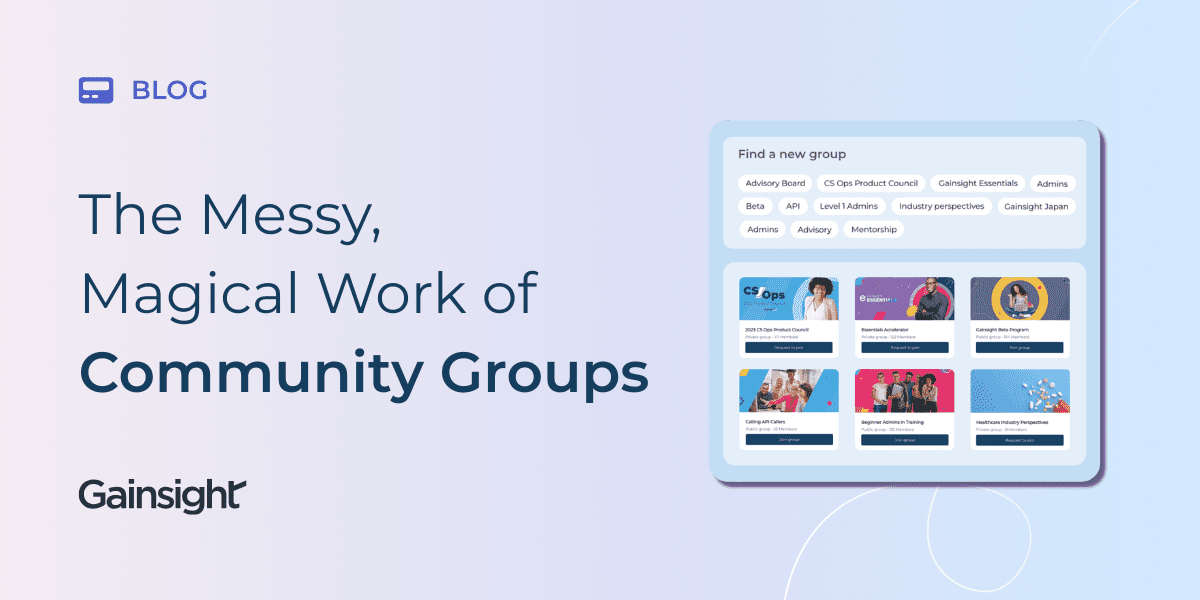

I’ve seen a lot of community teams spin up groups with the best of intentions … and then watch them quietly fizzle out.
And yet, groups are one of the most flexible, powerful, and under-leveraged tools for community-led growth.
I get a LOT of the same questions from community builders trying to breathe life into a group or wondering why one fell flat. So, I figured I’d answer them head-on.
⬆️ Curious for more?
I unpack all of this in the
Groupopolis episode of In Before the Lock.
Here are the seven most common questions about community groups, and what I’ve learned after building and scaling community groups at every stage:
Why Are Community Groups Important?
When community groups work, they really work. They become opt-in spaces where members connect around shared identities, interests, or roles. These micro-communities create genuine momentum.
Groups can be:
- A Women in Tech cohort
- A regional chapter like Silicon Valley
- A role-based group for advanced admins
Whatever the theme, groups help members filter the noise and go deep with people who just get it.
And for your business? When you get it right:
- Product teams get early feedback from power users
- Marketing finds fresh advocates and content
- CS gets another way to scale value
- Executives hear unfiltered customer sentiment
Done well, groups reduce support costs, create champions, and even generate pipeline. But only if they’re set up with intention.
What’s The #1 Reason Community Groups Fail?
Most groups fail because they start with software, not strategy. It’s tempting to spin up a group, slap on a name, and hope engagement happens. (Spoiler: It won’t.)
The real work is answering the foundational questions:
- Why does this group exist?
- Who’s it for?
- What’s your commitment to it?
- How does it tie to your company’s goals?
I can give you a million examples of where the teams I worked with before created groups that we thought were a good idea and just didn’t pan out. Sometimes they were too niche. Sometimes we just weren’t committed enough to sustain it. Sometimes we built it because an executive wanted it, not because users did.
If you force a group into existence, you might hear crickets. Just because you can create a group doesn’t mean you should.
My advice? Use a lightweight planning framework like V2MOM (Vision, Values, Methods, Obstacles, Measures) to build the spine first. Then build the space.
How Do You Keep a Community Group Active?
The secret to keeping a community group active isn’t content volume, it’s rhythm.
You don’t need 10 posts a day. You need something your members can count on.
What to Try:
- Weekly rituals like Topic Tuesday, Feedback Friday, or Win Wednesday
- Recurring AMAs featuring internal experts or customers
- Post templates to make it easy for members to contribute
Rituals = reliability. And that reliability gives your internal teams an easy excuse to promote the group, too.
How Do You Know What Content a Community Group Wants?
You don’t have to guess. Just ask.
- Run a poll
- Watch which posts get traction
- DM active members for feedback
You’re not crowdsourcing everything. You’re co-creating. The difference is subtle but powerful, and it makes your members more likely to invest in the group’s success.
Tend it like a garden: light, water, a little weeding. That’s how you get something that blooms and grows.
Can Internal Employees Help Lead Community Groups?
Absolutely—and they often should.
Some of the best community engagement comes from support reps, CSMs, and solutions engineers. The folks on the front lines have credibility because they’re in it every day. They’re thinking about how to save time, get ahead of repeat questions, and share what they know with a wider audience. Community groups can give them that outlet.
Empower them with:
- Social-ready post templates
- Event ideas like “Ask Me Anything” sessions
- Easy ways to invite users into the group
You’re offering them a more authentic, easier way to connect with their customers—one that actually feels personal and tailored on the other side.
Does Fun Really Matter in Community Group Engagement?
Yes, fun is a retention strategy.
Here’s what I’ve seen work well:
- Surprise swag drops
- “Caught Being Awesome” shoutouts
- GIF-only thread days
- Watch parties or milestone celebrations
Joy builds belonging. Belonging builds stickiness. And that’s what turns a group into a place people want to come back to.
What If a Community Group Flops?
Then … it flops. Learn and move on.
Groups give you the freedom to experiment small, start with a pilot, validate demand, and then scale intentionally.
Not every group will work—and that’s fine. A quick pivot beats months of sunk effort. It’s learn fast, pivot faster, and let the wins snowball.
Final Thought: Groups Aren’t Magic. But They Do Unlock It.
Community groups are like little ecosystems. When they thrive, they generate their own gravity. And that energy, when aligned to your goals, is one of the most powerful forms of scale you can tap.
So if your current groups feel stale, or you’re launching something new, zoom out and ask yourself:
- Do you know the “why” behind the group?
- Are you building something your members actually want?
- Are you giving it just enough structure to grow?
If you’re nodding, great! You’re on the right track.
Let me know what’s working in your groups and where you’re stuck. I’d love to swap notes.
Follow Erica Kuhl for bold ideas on how to help your customers learn what matters, adopt what drives real value, connect with peers, and succeed by orchestrating the entire customer journey.
