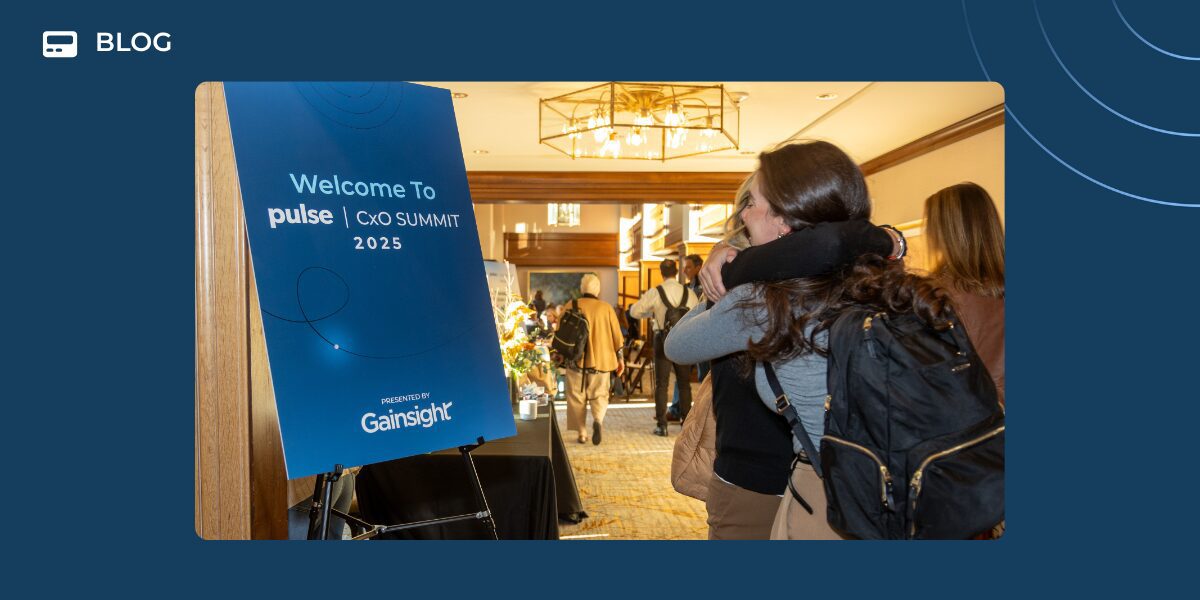

Gainsight’s CxO Summit is a rare forum where Chief Customer Officers (CCOs) and Chief Experience Officers (CXOs) drop the slides and speak plainly about what’s working now. The day and a half event took place in beautiful Park City, Utah this year and featured an incredible cohort of post-sales leaders across some of the biggest names in SaaS. My biggest takeaway from the experience, data, and dialog shared? Scale with intention.
Budgets Are Stabilizing—Cautiously
The 2023–2024 reset did its job. Budgets have largely stopped shrinking and many are starting to grow again—but at a measured pace. Chief Financial Officers (CFOs) want proof, not promises. Every new dollar spent needs a strong business case attached.
Headcount cuts have mostly stopped, in fact 63% of CxO attendees reported increasing investment in headcount, yet teams aren’t scaling linearly with revenue. New spend is instead going to digital tools (82% reported investing), like online communities, and even more to AI technology (85% reported investing).
As a result, ratios are going up—Customer Success Managers (CSMs) covering more dollars and more accounts. Specialization and digital programs are absorbing growth instead, without defaulting to headcount. Customer Success (CS) teams are investing in Technical Account Manager (TAM)/Account Manager (AM) splits, pooled resources for digital programs, and expert pods for onboarding, adoption, and renewal.
Agents & AI: High Excitement, Noisy Reality
Everyone is experimenting with AI agents. Outside of targeted use cases (support deflection, content drafting, internal copilots), proven wins are still rare. There’s confusion about where to start, how to measure success, and how to govern risk.
What’s Working Now
- Narrow, high-volume workflows with clear outcomes (e.g., triage, summarization, recommended next actions)
- Human-in-the-loop designs that learn from expert feedback
- A consistent success scorecard: precision, coverage, time saved, and business impact (Gross Revenue Retention (GRR)/Net Revenue Retention (NRR), cost per case)
Guardrails
- Start with contained use cases and explicit Key Performance Indicators (KPIs)
- Stand up lightweight governance (data, approvals, rollback)
- Ship weekly, not yearly—iterate toward reliability
Build vs. Buy in the Age of “Vibe-Coding”
AI-assisted prototyping (“vibe-coding”) makes it incredibly easy to spin up internal tools. Many engineering leaders believe they can build what they used to buy. They’re not wrong about prototypes—but executives are rightly cautious about maintenance, security, compliance, feature creep, and total cost of ownership.
A practical rubric is to prioritize “buy” for durable capabilities, especially those that touch revenue, risk, or Personally Identifiable Information (PII) at scale, and where you need best-in-class functionality and fast value. For more one-off, limited use cases where staffing and supporting internal builds isn’t a challenge, “build” may be a viable path. Build the glue; buy the core.
Return on Investment (ROI) is the Conversation—Twice Over
Boards want proof that CS drives GRR and NRR: the ROI of CS operations. The best teams:
- Tie activities to revenue mechanics (onboarding time → time to value → expansion rate)
- Instrument playbooks with outcome tags (risk removed, seat expansion, churn save)
- Report a blended ROI: cost-to-serve trends + revenue impact
CFOs also expect ROI from the software you leverage to deploy CS. Vague value stories are off the menu-CS leaders need a KPI-level claim with time-bound payback (e.g., “Reduce cost per account by 20% in 2 quarters,” “Lift expansion rate by 3 points in 6 months”). Increasingly, technology must deliver outcomes, not workflows, to add value.
Pricing: Seat-Based is Under Pressure
Many leaders are testing consumption, usage, or outcome-based models—sometimes as hybrids with seats. The intent is simple: better align price to value while protecting predictability.
These new pricing models need to be anchored to a clear value unit (e.g., active end users, automated workflows, learning completions), and cap risk with floors/commit.
Sales & CS are Rewiring Together
Sales is increasingly measured on GRR alongside bookings; CS is now comped on expansion. Among CxO attendees, 52% reported owning renewals, and 41% owning expansion. That overlap is intentional—and it demands a shared operating rhythm and shared systems. Separate data and disconnected workflows will tax both teams.
What “tight collaboration” looks like:
- One account plan from prospect to renewal
- Shared pipeline and forecast for expansions and saves
- Common definitions for health, risk, value, and whitespace
The increasing number of CS teams reporting into CRO’s makes this alignment clearer for many orgs. Aligned goals require systems that work together, with tight Customer Success Platform (CSP) and Customer Relationship Platform (CRM) integrations a must for shared visibility and accountability across sales and CS.
What Great CS Leaders Are Doing Right Now
There’s likely no other gathering with the same depth of talent and experience in CS like CxO Summit. Attendees at CxO had a few key approaches that are driving success:
- Portfolio mindset: Balance programs and projects that show impact, with a small allocation for high-conviction testing.
- Leverage by design: Specialize roles and scale with digital programs before adding headcount.
- AI with outcomes: Start narrow, measure weekly, and govern simply.
- Build-and-Buy discipline: Prototype freely; productize responsibly.
- ROI storytelling: Tie CS motions and software investments to GRR/NRR with time-bound metrics.
- Revenue team unity: One plan, one vocabulary, shared goals.
If you joined us at the Summit—thank you for the candor and learnings. If not, these takeaways and themes may help gut-check your 2026 plans and goals. We’re still writing the playbook on AI, agents, and how CS evolves in the agentic era, but these lessons showcase where to start and where we should lean in.
