How Agentic AI Is Replacing Subscription Revenue

150. Is Agentic AI The End of ARR? ft. Brett Queener (Bonfire Ventures) & Chuck Ganapathi (Gainsight)
Show Notes
Chuck Ganapathi, the CEO of Gainsight & Brett Queener, Managing Director at Bonfire Ventures, who previously ran product at Salesforce and helped destroy Siebel, the company where he and Chuck first met. Together, they’ve witnessed every major shift in enterprise software over three decades, and they believe the biggest one is happening right now.
In this conversation, Brett unveils his forthcoming thesis on “the end of ARR,” arguing that agentic AI will fundamentally break subscription business models. When products finally achieve what he calls “product purity”, actually doing the job they promise without requiring armies of CSMs, endless onboarding, and quarterly business reviews, the entire economic foundation of SaaS collapses. Chuck and Brett discuss whether this is an existential threat or the evolution the industry has been waiting for.
What you’ll learn:
- Why the “friction gap” between product and value created the entire CS industry
- What “product purity” means and why it threatens traditional SaaS economics
- How agentic AI fundamentally changes the unit economics of software
- Why usage-based pricing is inevitable once products actually work
- The product marketing playbook that still matters in an AI-first world
Key Takeaways:
- Customer success exists primarily because products failed to deliver value automatically—AI is changing that equation.
- The gap between what you ship and what customers get is collapsing; companies without product purity won’t survive.
- Product marketing is the new moat: if three competitors have similar products, the one with better storytelling wins.
- Your angriest customers are often your best source of product insight because they’re power users who see the gaps.
- CS professionals survive by becoming product experts who drive adoption, not relationship managers who paper over product deficiencies
In this episode, we cover:
- 0:00 – Preview & Introduction
- 1:18 – Meet Chuck & Brett
- 3:30 – How Brett and Chuck met at Siebel
- 9:28 – Transition to Salesforce: destruction of Siebel as a goal
- 14:11 – Changing Nature of Product Marketing in the AI Era
- 18:00 – Systems of Record vs. Systems of Action
- 21:13 – Databases as “lossy” representations of reality
- 29:00 – Brett’s thesis: “The End of ARR (And I Feel Fine)”
- 34:28 – How should agentic applications be priced?
- 43:43 – Future Outlook: Market paying premium for top agents
- 47:17 – 10x CSMs enabled by AI agents
References:
- Brett Queener’s blog: https://queener.substack.com/
Featuring

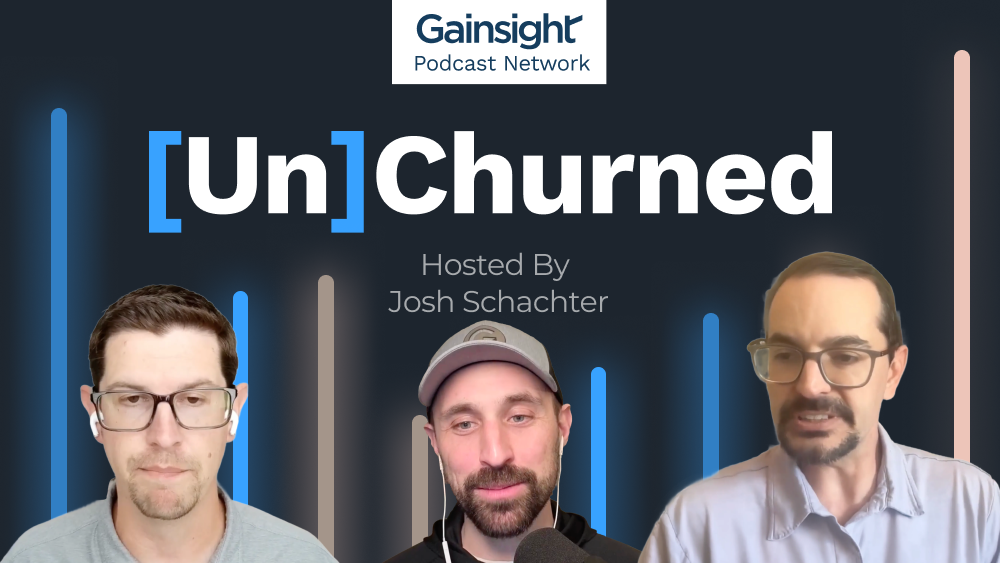
Josh Schachter, Host
SVP, Strategy & Market Development @ Gainsight

Chuck Ganapathi, Guest
CEO, Gainsight

Brett Queener, Guest
Managing Director, Bonfire Ventures
Transcript
Brett Queener:
When somebody starts using the agentic product, the intelligence and context are actually relying on the agent to do.
I think if you do a very good job, I think you could be stickier, at least as a category because it’s very hard for them to go back to like do nothing because that needs to happen. They need another least agentic solution. So it’s not all bad, but, you know, we have to completely probably rethink the classic SaaS magic number, you know, and cash burn multiples that were all based at Arrow that effectively basically allowed you to spend a little more than you probably should because of your ARR and churn.
Josh Schachter [Host]:
You’re listening to Unchurned, brought to you by the Gainsight podcast network. From the early days of Siebel to the meteoric rise of Salesforce, Chuck Ganapathi and Brett Queener have lived through and shaped the biggest shifts in enterprise software. They were there when CRM was just a three-letter acronym nobody understood. They were there when cloud software was written off as a fad. And now they’re here again and at the center of what might be the most profound transformation yet. The rise of AI agents. In this conversation, you’ll hear two old colleagues and old friends revisit their shared history, debate the death of ARR as we know it, and imagine a world where software doesn’t just record work, but actually does the work. Hey, everybody, and welcome to this episode of Unchurned.
Josh Schachter [Host]:
I’m Josh Schacter, your host, and I’m here with two very special guests for today’s episode. Uh, we’ll start with Gainsight’s own CEO, Chuck Ganapathi. Chuck, thank you so much for being on the show today to join us.
Chuck Ganapathi:
Thanks for having having me. Josh and Brett, it’s great to see you.
Josh Schachter [Host]:
Good to see you. Yeah. And Brett Queener. Brett. So Brett is the managing director of Bonfire Ventures. He is, in my opinion, the record setter of most, most roles on his LinkedIn profile. If anybody ever has been to Brett’s profile, you’ve got like 25, I think.
Brett Queener:
Don’t I also win for being like the most recent, most common host when you can’t find somebody else?
Josh Schachter [Host]:
I was gonna go there next.
Brett Queener:
I’m like, your back, Phil.
Josh Schachter [Host]:
Yes, yes.
Brett Queener:
Like, oh, Queener’s available. Let’s get Queener on.
Josh Schachter [Host]:
You know what, it’s funny because, like, in my mind, you’re one of the most successful VCs that I know. And I’m not ingratiating myself here because you are one of the wisest That I know.
Brett Queener:
You don’t know a lot of VCs, apparently, right?
Josh Schachter [Host]:
I just showed my colors there. No, I do, but you, uh, you’ve always got some really wise things to say. I’ll just say that. So that is why you also set the Guinness Book of Records with this episode of being the. The most featured guest on the unturned hats.
Brett Queener:
Like, there should be like a five timers club like snl, where I get like, some chalice or some cheesy jacket or something.
Josh Schachter [Host]:
Yeah, yeah, yeah. Well, I. I’ve been. I’ve been bugging the folks in marketing to get us the unturned hats, so that. That’ll be in the mail. You’ll be the first one, Brett. First one. We just need somebody to approve the budget.
Josh Schachter [Host]:
Anybody? Anybody.
Chuck Ganapathi:
I don’t know who that would be. I have no idea. Yeah, you’re here to hear I like your Gainsight hat.
Josh Schachter [Host]:
I’m digging it.
Chuck Ganapathi:
It’s pretty awesome.
Josh Schachter [Host]:
Yeah, yeah, no, it wears well. Okay, so, Brett, we had you on the episode for a few reasons here, and Chuck as well. You guys both have very strong, insightful opinions about the world of AI and where everything is going with agentic. And you both have gone way back. Actually, you’ve known each other for quite a while. So, Brett, I would love for you to explain to our audience, tell us about the origin of your relationship with Chuck.
Brett Queener:
Oh, boy. Chuck’s rela. My relationship with Chuck is so old that we met when you would use software by getting CDs shipped to you. So our relationship dates all the way back to Siebel, which was a on premise CRM provider. It was the fastest growing company in its time. It and Veritas were the two fastest growing companies in the 90s.
Chuck Ganapathi:
I forgot about Veritas, by the way.
Brett Queener:
Those are the two fastest growers.
Chuck Ganapathi:
Did you know Nick worked at Veritas?
Brett Queener:
Oh, really?
Chuck Ganapathi:
Nick Mehta, our prior CEO.
Brett Queener:
I didn’t know that.
Chuck Ganapathi:
I actually met Nick before I met you. He was a CEO of a dot com company called chipshot.com, oh yeah. Which he started right out of Harvard. And then he came to recruit at business school, which is when I met him. Thankfully, I didn’t go work for that company. But he did great after he went to Veritas. Worked for some legendary people at Veritas, and, you know, that’s how his career took off. And then he did great.
Chuck Ganapathi:
But like, yeah, Veritas and Siebel were back in the day, the darlings.
Brett Queener:
Very fast growing on premise software company in the CRM space. And then I went to Salesforce first.
Josh Schachter [Host]:
I mean, it was the CRM company, was it not?
Brett Queener:
Back in the late 90s, it was the CRM company.
Chuck Ganapathi:
Well, we invented the phrase CRM people. You know, Mark, obviously, Salesforce’s stock ticker, CRM. But the word CRM was invented at Siebel.
Brett Queener:
Yes. So when I moved over to Salesforce, the whole idea was to destroy Siebel. And trying to figure out which of the folks that I work really well with in the old generation of software I thought would inject the necessary level of energy and focus into the new era. And so I can’t remember, I was involved in your recruitment.
Chuck Ganapathi:
What Was it you were?
Brett Queener:
2004? Five.
Chuck Ganapathi:
Well, actually. So 2005 was the first time around.
Brett Queener:
I think you started out in product marketing.
Chuck Ganapathi:
Well, actually, if you actually go back in 2005. So I left. No, no, no, no, no. So the history. History is a little bit mangled there, but just going back to Siebel days. So the reason Brett and I get along so well is, you know, he’s been known as a tough guy to work for, but once you work for him, you don’t want to work for anyone else. Right. Like that.
Chuck Ganapathi:
He breeds that kind of loyalty. And there’s so many CEOs and executives in large companies that used to work for Brett now running big companies or big organizations that would tell you that that there is. They have not had a better boss. And I can tell you emphatically, I’ve not had a better boss than Brett, and I’ve learned so much from him. But it actually started with, you know, but he was a tough guy. He’s a tough guy to work for back in the day. He was feisty. Let’s just say in.
Chuck Ganapathi:
Back in the Siebel days, we all.
Brett Queener:
I’m getting.
Josh Schachter [Host]:
I’m getting Bill Campbell vibes from. From this. You know, Brett, were you, like, the coach. Were you the other coach in Silicon Valley?
Brett Queener:
A little. Probably a little more Harbaugh. Yeah, I think, Bill.
Josh Schachter [Host]:
Oh, really?
Brett Queener:
I think people can put up with Campbell longer than they can put up with Harbaugh, you know, but, hey, so he was my.
Chuck Ganapathi:
He was my. So I was building this product called Siebel prm. We used to be called E Channel, but Siebel prm. And Brett at that time was running alliances for Siebel, working for a guy called Bruce Cleveland. You know, Bruce. Right. So we were obviously wanting to dog food the product. So Brett was like, I need to use prm Siebel PRM to run my alliance organization.
Chuck Ganapathi:
So here I was, a fresh newbie product manager at a business school and there’s Brett. And I’m scared shitless to go in front of this guy because he’s known to like eat people alive. And I go there and we start whiteboarding, like what this thing has to do. And I was like, actually this guy’s good. And he’s like, that’s exactly what we should build. So I actually just went and built what he was asking for. And that’s how we became friends and got you.
Brett Queener:
We had custom built one with Sebastian Rivera, remember?
Chuck Ganapathi:
That’s right.
Brett Queener:
We had custom built our own PRM for our own use at the time. But yes, anyways, and then checking.
Josh Schachter [Host]:
So going back to Siebel, I remember a couple of years ago I read Geoffrey Moore’s book, I think it’s called Inside the Tornado. And we’ve had him on the podcast. He’s been at Pulse for Gainsight before and he was talking about the early days of Salesforce, that they would go literally just banging on the drums outside of the Moscone. Is it Moscone or Moscone, I don’t know how to pronounce it. At the Dreamforce conferences and just making a big ruckus and saying that on prem is dead. Was that you guys? Were you literally thereading in the streets?
Brett Queener:
No, actually I was running our user conference and then I went to go run marketing at Siebel Worldwide Field Marketing. We had to go create our own leads because we ran out of partners to sell our own software back and forth, you know, like, what’s going on right now with OpenAI, Oracle and Nvidia, you know, they’re all moving $100 billion around with each other. Siebel invented that shit. Okay. And so when we ran out of the partner jamscan, and then there was the Crystal Watch stock report. Back in the old days, you just get tons of stock cause it was never expensed. We had to actually go create our own demand. This is post sort of like the dot com crash.
Brett Queener:
So we’re running our giant user conference in France. And outside these people are protesting from Salesforce. And everybody was like, the people that couldn’t take a joke were really mad. But like, guys, Chuck and I would be like, oh, it’s pretty clever. You know, we came over to Salesforce about that time, which was really, I think, a really huge inflection point, which was sort of figuring out the best of how we did our functions and ran it in an on premise world, but reimagining what it would be from an on demand delivery model. And you know, I think Chuck and I had a ton of very formative years together in the product organization. There was a weird time when they let the inmate, the biz ops guy like me run product. Now I did code in high school, so I am a secret dork.
Josh Schachter [Host]:
What language did you code in high school, Brett?
Brett Queener:
Basic. My first computer was a TRS 80. That’s how old I am, right. With the phone on the side. But you know, we basically.
Chuck Ganapathi:
Just to be clear though, I just want. I just have to stop you right there. Like you call yourself like the oh, the biz ops guy. Inmate running the asylum. All I can tell you about Brett is there are I don’t know how many other people that I can think of in enterprise application software industry that have the mix of the understanding of what is good product like good product thinking and good go to market mechanics. I think you call it go to market mechanics, right, Fred? That combination, I swear to God, I don’t know who else I can think of that can be both great at product thinking and. And go to market mechanical thinking than breadth.
Brett Queener:
Well, I think the key thing is they’re interrelated, right? Like where companies go poorly is they mismatch what their product is or the footprint or usability or et cetera with the go to market function. It’s like don’t do that. But anyways, we had a lot of fun, good times at Salesforce. And I think what do I say about Siebel and Salesforce? What we had there at both of those organizations that most companies don’t have is phenomenal product marketer. Like, you know, at our core, Chuck and I can do many, many things. But first and foremost, we are a storyteller, right? If we want, you want somebody to come and say, you know, there’s a crack in the ground, the world has changed. You now need to be like this. Therefore you need these capabilities.
Brett Queener:
And oh boy, do I have the software to do that. And then to take that and then go to market perspective, make sure the first time somebody in the sales organization at top of funnel, mid funnel, et cetera, sets the competitive frame, validates that frame and takes out the competition. I would say Chuck and I are very good about that. And I think the other we learned.
Chuck Ganapathi:
We learned from the master, from Mark, he’s a master at that.
Brett Queener:
And then I think the other reality is that Salesforce my model and because remember when I took over A product at Salesforce we had one product was a mid market SFA product that was too hard to use for SMB and it wasn’t sophisticated for enterprise. We hadn’t completely exposed the platform, there was no app exchange, the API was rickety and. But at the time, did you know.
Josh Schachter [Host]:
Did you know, did you know this was, I don’t know, Salesforce’s market cap, but did you know this was a hundred billion dollar company in the making or were things much more spaghetti than that?
Brett Queener:
Look, no, you never know because at the company it’s always a shit show. Right, but you know, we do a good job of hiding that. No, but you know, and so, but at the time the entire on premise market wasn’t going any adjacent categories. So I was like, I need business leaders to run product lines and general managers who think like a business, don’t manage anybody other than product people, but are responsible for driving and influencing the entire rest of the organization to the point that the executive off sites, the PM leaders had to present on the business and cross functionally sales and others would participate. But if we didn’t make the sales number or there was a churn number, it was the PM’s fault. And so Chuck was one of those and he ran basically our cash cow business which was the sales cloud business and was heavily involved with me and you know, we didn’t get the platform people to give us an API that we could have been the feed of feeds and not spend 30 billion for Slack. But really you know, think about Chatter or collaboration within applications that didn’t exist in enterprise software before, before Chatter or Slack or the Yammer. If you had 30,000 people at Cisco in a piece of product logged in at the same time, you wouldn’t know there was 30,000 Solitaire experiences.
Brett Queener:
So Chuck was heavily influential in driving forward how do we take this enterprise software, make it collaborative. But anyways that’s that was, that’s how Chuck and I got to know each other very well.
Josh Schachter [Host]:
Brett, I want to go back to something you said a minute ago. Commercial time out here for you. I’m a huge fan of your blog Tales from the Bonfire. But anyways, you know, I don’t know if it was the last one. I think it was maybe a couple articles ago, maybe like six months ago you had written something along the lines that product marketing was the most or a product marketer was the most important role now in the world of Gen AI. Right? Was that, Am I getting mixed up?
Chuck Ganapathi:
Was that you?
Brett Queener:
What I said was if you take Three people in a category, and if the products are roughly the same, if one’s the winner versus the other, they have far better product marketing. They just do. And what is product marketing? Product marketing is the ability for you to communicate what jobs you do for a customer that they care about far better than competition. And you either can communicate that, and you align your marketing and your product roadmap around that, and you take out the competition. Or you live in a category with 15 different vendors and no one separates themselves. What I said was most companies are terrible at product marketing because what I’d say Chuck and I are good at in product marketing, you need to synthesize a lot of data, what’s actually going on, and then how do I take that and communicate it? Chuck and I were very good. You give us three sales calls. We’re like, oh, shit, okay, I got it.
Brett Queener:
There was no gong. Now we can listen to 1000 calls to a thousand emails, and pretty quickly leverage AI to summarize what’s going on. So now synthesis is solved. And then now with AI, there’s increasingly we can leverage AI to take that and allow you to permeate that, you know, through all your execution channels, whether agentic or human. And the reality is, the other big thing, why it’s super important is usually you would release a product like once a year. That was. You really would be like, I’m changing how to train the salespeople. It’d be like Dreamforce.
Brett Queener:
And Chuck and I always, always negotiate. Well, can we Show Something that’s 2/4 away or 1/4 away? What are we showing? But, like, your value prop didn’t really change. Your competitors didn’t change. That’s changing, like, every four weeks. Like, I have companies that are native AI companies that grow $20 million a year, and then, oh, my God, they gotta refine product market fit. So if that. If the rate of change is that high and it’s very important I tell you how important product marketing is, then how do you make sure every three to four weeks that people can understand it? Because when I look in the slack orgs of my native AI companies, it’s a little bit of a shit show. They’re just releasing stuff left and right.
Brett Queener:
No one has any idea what’s coming out. If you ask them what definition of GA is, they laugh at me. They say, okay, Boomer, you know, ga, you know, they asked me if I’m using a comedy 64. So golden master.
Chuck Ganapathi:
How about the Golden Master?
Brett Queener:
The Golden Master cd? But anyways, that was the Point around product marketing.
Josh Schachter [Host]:
The most successful founding teams that you see right now are those are the ones that are able to roll with the changes and adapt as quickly as possible to what they’re seeing in the market and affect their narrative differently.
Brett Queener:
Yeah, it’s not right. If a customer comes to Chuck and says, hey, Chuck, I’d like you to do this capability. Six years ago, Chuck’s like, well, I gotta hire two or three scrum teams and then, oh, if it’s important, then I gotta upset these other scrum teams and we gave them agency and now we’ve told them it’s not important and then they spec it and then we do designs and then we go do testing and then Dev forgets to ship the designs and then you buy Pendo or something to track it guides in the rest of it. Blah. The reality is you probably could ship that thing in three weeks if he has the data model, has the context. Yeah. So it’s completely changed.
Josh Schachter [Host]:
And you’re. I know you’re coming out with the new blog soon. Thank you for that. The last one, it was all about this transformation from software going from systems of record to systems of action. Tell us more. For those that haven’t read the article yet. Well, tell us more.
Brett Queener:
Well, I was, I was being a little controversial. What I was really talking about was, is fixed schema important or not? Because if you look at lovable and look, I don’t build enterprise apps with lovable. You tell lovable what you want. Dah, dah, dah, dah. You don’t tell it what fields you want. You don’t tell it your data model. You just say, this is what I want. And it will produce a ux, some workflows and it’ll figure out the underlying database or schema that you need.
Brett Queener:
So what I was really thinking about was the important to fix schema. And what I really love about the AI agent I started writing about. I don’t. More than a year ago, where I was like, oh my God. Everything that Chuck and I are masters on is getting blown up. And this is fun and we have enough context for the old way to sort of really appreciate oh my God. Because for the first time since I started working with software, I got to business school because I was Jimmy Neutron and a manufacturing company that was working on deck vaxes and I had a Windows 3.1 computer. Windows 95, remember the start me up.
Brett Queener:
And I built.
Chuck Ganapathi:
We are old. We’re so old.
Brett Queener:
I built a CRM database. I built a CRM database in Visual Basic and there was no email and I carved off the regional manager hard drives on a zip drive I FedExed it to and by Friday I would consolidate it. Yeah, so by the way, I don’t.
Chuck Ganapathi:
Think Josh has heard of half the terms you just said.
Brett Queener:
Okay, sorry. So my point being is what’s really exciting, and this one I wrote up before is we are delivering software that actually is super valuable. It actually helps you do your job or does a part of it or takes or does the full job of where you have employees doing sort of grunt work today. That’s super exciting. And so that changes sort of everything. And so all I was doing in the schema article was retesting this assumption around, oh, as a software vendor, you should buy this software for me because I have this schema that knows everything. But then you have to take it and spend all this time configuring it and hiring consulting to take your context, which is how you run your business, and then go put it in that schema. And I think it’s wrong.
Brett Queener:
I think with AI and the rest of it, I can go to Gainsight’s website and go, if I’m selling Chuck a CRM, looks like you’re a software company, which segments do you serve? Are you inbound or outbound? Da, da, da. Okay, I assume you do quotes and et cetera. Give me some terms. And then, hey, from a process perspective, you generally want to look at this. And then in analytics, I’m not going to make you create a bunch of dashboards that have seven friggin dashboards with seven meters. Well, what’s that say? Or what to do.
Josh Schachter [Host]:
I would be like, okay, we get it, we get it, we get it. You’re perturbed by all this. Yeah. So Chuck that was quoted the article. Yeah, so, so your old manager here, old, former, old, whatever, is shooting daggers at Gainsight, right? I mean, Gainsight is the CSP is a system of record for customer success. Right?
Brett Queener:
I didn’t shoot daggers.
Josh Schachter [Host]:
Well, I want to give Chuck’s take on this.
Chuck Ganapathi:
Look, look. Okay, so interestingly, when I, my first job as a product manager was in 1999 at Siebel I told you about, my first customer was Brett. At that time, when I joined the company, there was a guy at that time who, who used to work on the product that I worked on Siebel prm. His name is Arun Balaraman. And now he’s at, he’s at Google. And when I joined, he said, hey, you know, you have to write this Thing called an mrd. And in that MRD you have to write, you know, requirements doc. And I have a template for how to write, how to describe the UI that you should build that you can communicate to your engineers.
Chuck Ganapathi:
Basically what we would use today, Figma for, right? And the tool he gave me to draw UI to give to my engineers, do you know what it was?
Josh Schachter [Host]:
Microsoft Paint, pen and paper?
Chuck Ganapathi:
No. No, it was frigging Excel. Just believe that, I’m not making this up.
Brett Queener:
That’s right, you would make a box.
Chuck Ganapathi:
Because in the Excel we would make a box for the form and it had a bunch of fields and there’d be another form below it with a table because it was easy. One cell would be the name of the database field, next cell would be empty because that’s where the actual value goes. And so this is how we would actually draw UI mockups. In 1999, as a product manager, my UI mockups were made in Excel. That just goes to show you how schema centric we were. And in fact, I would give advice to other product managers. Back then I said the most important skill you have to learn when you join Siebel as a product manager, Mostly we hired MBAs, right? Most MBAs didn’t, had never worked in technology before. I was an engineer like Brett was before business school, so I kind of got it.
Chuck Ganapathi:
But for most people, they don’t, they go through business school, they would join Siebel and I would say the most important skill you need to learn as a PM is erds, right? Entity relationship diagrams of how schemas, fields, you know, one dimensional relationships, many to many relationships and all of that stuff, that’s how we thought about what software was. And to Brett’s point, if you think about the world as it is today, what we learned from companies like GONG was that actually if you think about what a deal is, what an opportunity is, it’s not a collection of fields. It’s the collective knowledge and the collective wisdom of the salesperson, the manager, the sales se, the, you know, the sdr, all these people that are working with the customer, it’s the stuff that’s in their heads. And if you’re able to pull all of that together and create one document, the narrative of what’s happening, well, that’s your deal, that’s the opportunity you’re working on, not a bunch of feels. In fact, one of our board members, in a recent board meeting here at Gainsight, one of our board members from Vista said, when I described this problem, he said, it in the most beautiful way that I really stuck with me. He said, oh, I get it, Chuck. What you’re saying is that a database is actually a lossy way to store what is happening with the customer. Right.
Chuck Ganapathi:
It’s not lossless compression, it’s lossy compression. It’s like taking a high quality picture that you took with your, you know, 150 megapixel camera and making a grainy, you know, JPEG out of that. Right. That’s what’s going on with database. I couldn’t agree more with Brett, that I think describing business relationships, customer relationships, what’s going on with your customer in any business, into a database form, I think is the way we did software in the past, for the last 20 years. I couldn’t agree with them more that it’s over. So I don’t think of this as like him shooting darts at us.
Brett Queener:
No. And in fact, we’re not. And the fact is it’s not against schema. If somebody’s been in schema for a while, solving a problem like Gainsight has, which is customer success, if they should have the context. Because where’s context come from? There’s conversations and other data points and there’s structured data. But when you want to build agentic systems, well, it has to speak to context. And Gainsight isn’t SAP. It’s not in 17 horizontal verticals.
Brett Queener:
It’s not trying to solve 15 jobs to be done right. It’s trying to deliver success or retention as a service. And so within that, you have a lot of domain expertise. And if Gainsight doesn’t actually deliver, if I will the systems of actions or engagement on top of the system of records, well, that would be a shock given what I know it would.
Chuck Ganapathi:
I. I agree. I’ll give you one example to make that real. So the bane of Brett’s existence, back when he was running sales ops for all of Salesforce. Right. This is before he was a. He became our chief product officer. The one thing that every new CRO that would join Salesforce would ask.
Chuck Ganapathi:
I want all of my reps to fill fill out account plans. You remember that, Brett? Okay.
Brett Queener:
I didn’t even care if they were good. I just wanted them to fill it up.
Chuck Ganapathi:
Okay, here’s the thing. No rep worth their salt wants to fill out an account plan. No person.
Brett Queener:
You should have seen the schema of that custom object that I got in Salesforce. Beautiful schema.
Chuck Ganapathi:
So nobody ever wants to do that.
Josh Schachter [Host]:
No.
Chuck Ganapathi:
CSM wants to write this big story in a success plan. So you Know what we did the latest. So we’ve had success plans in Gainsight for many years and it’s used a lot within our customers. What AI has allowed us to do is the latest feature of Staircase, which Brett, you will appreciate a lot having fought with so many salespeople around Account plans is Staircase will look at all of your previous customer relationships that expand it. So it’ll go. We build three agents, okay, three AI agents that go back in history over a certain period of time. And it’ll look at the relationship, how it began, and then how the customer expanded over time. And then using AI, just purely looking at meeting transcripts, emails, usage data, all of that unstructured data with a little bit of structured data sprinkled in will find the patterns of which, at what points which customers become the perfect candidate for an expansion, for an add on, for a cross sell.
Chuck Ganapathi:
And then it’ll go take those same patterns that are detected, apply it to the current context, and for every customer will tell you what is the expansion opportunity. And then it automatically updates the success plan or the account plan. So basically a human is not sitting around doing the research, success plan and.
Brett Queener:
White space analysis all in one, everything all in one.
Chuck Ganapathi:
It does, all of it automatically updates it into a document. To me it’s like that is the power of not relying on schema and not relying on human data entry, which humans don’t hate doing. Like, who wants to fill out forms?
Brett Queener:
Yeah. So as you can tell, Josh, I was not picking on my friend.
Josh Schachter [Host]:
No, I knew that I had to sparkle. I had to rile things.
Brett Queener:
He’s trying to rile. He’s trying to rile us out.
Josh Schachter [Host]:
You know, I like to pick and probe there. Okay, so we’ve gone from structured schemas, databases, to unstructured insights, and from systems of record now to systems of action, I. E. Agents. Brett, you’ve got some strong thoughts on the agentic world that’s, that’s here now and that’s to come. And of course, all of your startups now are immersed in that. Tell us more. Tell us about.
Josh Schachter [Host]:
I’m going to foreshadow your next blog article for you. Tell us about Agents and the Death of Arrow.
Chuck Ganapathi:
Ooh, spicy.
Josh Schachter [Host]:
I’ve also put him on the spot here talking about a blog he hasn’t written yet.
Chuck Ganapathi:
Did you say Death of ARR?
Brett Queener:
Yes, the title.
Chuck Ganapathi:
I’m gonna tell my board I’ve killed my ARR.
Brett Queener:
Let’s just see how old Josh is. Chuck will get this reference. The title of the blog is the end of ARR and I feel fine.
Josh Schachter [Host]:
End of the world as I know it. Yes, yes. But I like the death of ARR better. It’s more of a hook.
Chuck Ganapathi:
It’s.
Brett Queener:
It’s the end of ARR and I know and I.
Josh Schachter [Host]:
You’re the product marketer.
Brett Queener:
No, and I feel fine about it. I feel fine about it. Not like if I was trying to run these businesses. I feel fine because I think we think about where gainsight’s going with this product or the product it has. And I’m sure it’s the first of. Much of the evolution of gainsight is we’re getting to product purity. We’re getting to products that actually do the job. Which it’s funny because did you just coin something?
Josh Schachter [Host]:
Did you just coin that? Now, product purity. Have you heard that before? I really like it.
Brett Queener:
I’m just making this stuff up.
Josh Schachter [Host]:
Great alliteration.
Brett Queener:
Think about like what Chuck and I are masters at product marketing. All this stuff.
Chuck Ganapathi:
Speak for yourself, Brett.
Brett Queener:
In the old world, the gap between the product you shipped and the value somebody might get was so wide that there was all this friction. In fact, I’m not sure there’s a gain site if that friction doesn’t exist. Now the fact that product orgs thought that we would have a poor success person that would fill all that gap and it was going to be a magical QBR that was going to solve it, God love it. But now we move to a world where the product actually either does the job to be done well or it doesn’t. Okay, so within that, if we now think about that, are we buying software in a year or 18 months or when I’m sure customers will say, hey, they’re not going to say what did you buy to solve this customer success? They’re going to say, who did you hire? Because if we start to think of our products as assistants, you know, like a year or two ago I would walk into founders talking about AI and they look at me like, oh, you’re some stupid VC with your memes and AI or customer’s not asking for AI. Like really go to your customer and ask them if they hired somebody who worked 24 by 7, never go to Glassdoor, never complain, knows everything about the function and knows everything about your company in six hours and would do these four things for you, what would that person cost? They’re like, I don’t know, like 250k. What if every one of your reps or every one of your CSMs could have that tomorrow? But maybe it was 50K. And they look at me like, okay, I know what you’re saying.
Brett Queener:
And so we start thinking of our software as an assistant and whether it’s a copilot assisting a human or it’s somebody who goes and does a job. Well, what gets interesting is in the ARR world now. It was ironic. In my story I chart back when I first joined Salesforce, you rented by the month and you could leave whenever you wanted. Turns out that was hard from a cash flow basis because Salesforce raised in total. I looked this up, Chuck. $18 million in total capital. And in back in those days, we had to take money on a month to month SMB deal and take half of it and buy sun servers and put it in the Equinox data center that poor Klaus Bolt ran.
Brett Queener:
Okay, talk about efficiency, right? And so like, well, that’s not gonna work. And so we moved to like, oh, give us a year up front and do an annual contract. The annual contract was great because then you could predict what your revenue is gonna be. So you could hire from an OPEX perspective. But now if we flash forward and you go, if I said to you, tomorrow, I’ve got an amazing account for you, Chuck, they’re $250,000. But here’s the thing, Chuck. They want $250,000 immediately when they start working for you. And they’re on a two year contract and if they suck, you can’t fire them for 10 years.
Brett Queener:
You’d be like, what? What? And I’m like, exactly. So what’s interesting, there’s all this talk about pricing and packaging which is like, oh, are you paying for outcomes? Are you paying for usage? Are you paying for this? But no one’s really talking about contract term and contract commitment. And so in this article, what I dig into is why might this be a net positive? What’s the negative for how you run your businesses? As a software company, what’s the net negative? What’s the net positive? And what’s the net negative or net positive for companies? Now what’s interesting, the assumption would be like, oh, this is a shit show for software companies and I’m not gonna be less sticky and da, da, da, da. And I will tell you the following, which is different. The reason why people use Gainsight, especially the software customers at Gainsight, it’s in the world of ARR. It’s all about NRR, right? You know, world class companies got 89% GDR, it’s got 130% NRR. No leaky bucket. Then, oh my Goodness.
Brett Queener:
And then if you can do that for like seven, eight years, you could like last to fifty hundred. You get last to a PE exit. Not all of them go public. And so. But you need gainsight to make sure customers successfully don’t leave you because they can leave you because look, at the end of the day you’re a piece of software that they, the intelligence using the software is in people’s head. They use you, they put the data, they manage the workflows that they set up or your CSM help them, or PS et cetera, et cetera. But the competence, the expertise is in the customer’s head. So if they decide to leave your product, there’s seven, they either like, forget it, it’s not important enough.
Brett Queener:
That’s the worst. Like if you were in that category, as we see in the consolidation, the sales tech stack, or like I’ll go use this other thing. In this world, when somebody starts using the agentic product, they’re basically outsourcing that intellect. They’ll supervise it a bit, it’ll start to do the job, et cetera. And that’s no longer a piece of thing. They know really well the intelligence and context they’re actually relying on the agent to do. And so I think if you do a very good job, I think you could be stickier, at least as a category because it’s very hard for them to go back to like do nothing because that needs to happen. They need another least agentic solution.
Brett Queener:
So it’s not all bad. But we have to completely probably rethink the classic SAS magic number and cash burn multiples that were all based on ARR that effectively basically allowed you to spend a little more than you probably should because of your ARR insurance. So that’s kind of the article. And then I’m getting into then what are the implications then for how do we think about the role of product in success? That sort of. There’s a lot more overlap now the interlap between success and sales. I’m seeing sales success is actually coming much earlier in the sales process. What does it mean from a capital constraint perspective? And then how do I think that the CS function probably will evolve?
Josh Schachter [Host]:
Let’s pin that for now. Let’s pin that. I want to end on that one. So, Chuck, I’d like your thoughts in response to Brett’s conjecture here.
Chuck Ganapathi:
Well, I have a lot of questions. I have questions, as they say, because I love it. I think my big takeaway from what you just said, Brett, was brilliantly said is that for the future of agentic applications. I’m not saying agentic platforms, but agent or agent builder platforms. There are a lot of people, you know, Agent Force is an agent building platform. Right. So ServiceNow’s platform and so on, but you can build your own agents.
Brett Queener:
Great.
Chuck Ganapathi:
We’re not talking about that business. We’re talking about the business of vertical agents. Or what we used to call apps back in the day are now vertical agents. Right. Like I have a vertical agent for customer support, I have a vertical agent for customer success or adoption or renewals or whatever. And what you’re saying is you have to think of these as virtual employees as opposed to applications. And I completely agree with that. It also what I also you use the word you’re outsourcing that expertise, which then tells me that us as software company builders have to start thinking the mindset, I don’t mean necessarily the mechanics, but the mindset of a bpo.
Chuck Ganapathi:
Because you have to kind of think.
Josh Schachter [Host]:
Of almost like, sorry, sorry, sorry, sorry, Chuck, not everybody listening is going to know what BPO is.
Brett Queener:
Yeah, but a BPO that could afford to hire really expensive smart people. Because historically BPOs, you standardize a process and you put sort of low cost labor, you’re not putting in super high.
Chuck Ganapathi:
No, absolutely. What I’m saying is the, the, the BPO is business process outsourcing. Right. So if I want to outsource a call center, I can go to a BPO BPO and they’ll, they’ll say, oh, you want a 50 person call center will set it up for you and it should be in an offshore location, Therefore cheap or SDRs you can go. We in fact use an SDR outsourcer that you have your in house SDRs and then you have an outsourced SDR team that’s kind of like your, you know, like your team but sitting at another company at a different location. But the way you described what you just said is you’re kind of outsourcing to this company, the vendor, the software vendor. But the software vendor doesn’t have humans sitting and typing, calling, emailing, it’s agents doing the work, whatever that work is. So it is an agentic bpo.
Brett Queener:
Yes. And what the thing is, the reason why these AI companies are valued higher is that if you can do that, they’re going to pay you more for that because you replace that payroll spend. So you don’t get to pay, get more and get annual contracts upfront.
Chuck Ganapathi:
100%. 100%. The very simple math that I typically use is let’s take an average employee, and the average employee is, say, $100,000. OTE just making that up just from easy math. And let’s say you buy a piece of SaaS software to make that employee more productive, okay? And let’s say that software makes that person 20% more productive. So what’s the value you’ve created on the 100,000? You’ve created an additional value of 20,000.
Brett Queener:
And maybe you get 2, and maybe.
Chuck Ganapathi:
You get 2, AND you get 2. And guess who keeps the 18? The company. So as a provider of the technology that just gave you 20% productivity, the economic rent, as Robert Smith, our CEO of Vista calls it, is $2,000 out of the $20,000 productivity gain you have. So you keep 18. I, as the vendor of the technology, keep 2,000. So I basically got a very tiny portion of the economic value I just created with my technology. Now flip that book and flip the page and look at the agentic BPO kind of idea. Now, let’s say this is a job that there’s nobody doing, or it can’t be done and you have to hire again.
Chuck Ganapathi:
If you were to spend for a human, it’s $100,000. But if this agent can do that job, whatever that job might be. Now, let’s say you say, I want, you know, instead of you paying $100,000, you pay me $20,000 for the agent doing the job to the vendor. The benefit that’s accrued is 20% of 100,000. So massive amounts of value creation for the vendor. Now you have to deal with things like, well, the contract terms are different and you don’t get paid up front.
Brett Queener:
One thing we haven’t figured out is like, why would I have to hire 10 people? And you don’t need 10 agents. So that’s the tricky one.
Chuck Ganapathi:
I understand. So my question to you, Brett, this is the question I was going to ask you. The math makes sense, right? Like the value creation. If you simply have a mindset of an agentic bpo, not that you are an agent, you’re not a bpo, right? Like you’re a technology vendor. But if you have the mindset, then you start to think very differently. But my question to you is, how the heck do I price this thing? Because I’m not going to go and say, yeah, it’s 20% of $100,000. Because you’d be like, well, you’re crazy, because I know you’re using. You know, this is not a human.
Chuck Ganapathi:
And this person can, as you said, rightly this agent works 24, 7, 365. Right. So how do you price this?
Brett Queener:
I think it depends on is it an outsourcer that does the same level of quality of the work as a human or significantly better. And the more that it’s significantly better, I get closer to charging $100,000 as opposed to 20. I don’t have the answer yet, Chuck.
Chuck Ganapathi:
This is the question.
Brett Queener:
Yeah, there’s a pricing and packaging when we’re going to wrestle through. I think the thing for me, remember you started at the beginning that we were product purists. And you know, to some extent Chuck and I both left Salesforce because we were such purists on product that we, whatever, we’re like, ah, this is not the way to do it. Honestly. I mean, ironically, I think for me this, it brings us back to product purity. Like your product either does this job really well and the customer can see the value of that, or it doesn’t. And yeah, you know the good news, as an investor, I think zombie SaaS companies disappear. Like, you know, now I know why Vista’s investing so much in AI labs.
Brett Queener:
Because like the old PE model where I’m just gonna like, I’m just gonna like not invest in the R and D and just take the revenue stream is like, no, no, no. That revenue could completely go away.
Josh Schachter [Host]:
So anyways, Vista’s all in on the agentic factory. But Brett, you’ve always been very forward thinking. You’ve actually always been a pretty good prognosticator of the future. So at what point do you think the market becomes more comfortable with charging 70, 80, 90, 100% of what that displacement cost is?
Brett Queener:
I’m already seeing it. And where I’m seeing it, interestingly is so I invest the companies really early. Like I was with the founder the other day and they gave me their pitch. They were in some vertical solving this problem and then they thought the TAM of the market, they were almost too small. And so they pitched me that this problem I solved, I’m going to do this horizontal problem for all industries. And I was like, I’m not investing in that. You just lost your context. Yeah.
Brett Queener:
And the founder was looking at the TAM in the market and what people spent on software.
Chuck Ganapathi:
Yeah.
Brett Queener:
As opposed to how could you leverage AI and software to run those businesses better? And if you started to look at that, the TAM was 10x, I’m an investor in the legal AI space. And you’re like, what the hell? What are all these? Every day a legal AI company raises $100 billion. I have a company that’s gone from zero to $20 million in two years selling software to lawyers who never used.
Josh Schachter [Host]:
Software before because they don’t have to pay for paralegals. It’s a fraction of the cost.
Brett Queener:
It’s not that in the end of the day, they got to hire less paralegals. Like law firms in the past, they only have x amount of lawyers. There’s this whole thing where they get cases and they refer 50 to 60 cases to other firms because they can’t handle them. There’s a whole vic system that goes around and you get emails like, oh, dude, I only outsourced 10%. Now, because I use your software, I can immediately understand all the nuances. Think about lawyer. You get all these medical records and cases and et cetera. You’re up all night trying to figure it out.
Brett Queener:
Well, look, if I can extract that schema, build a database and then put a on top of it, I can give a lawyer case intelligence pretty quickly and understand that on page 131, it looks like there was something wrong with that guy’s neck that was missed. Da da da da da da. That lawyer who bills it two to five million dollars a year in, you know, in med mail. But if it’s mass tort, they may make two, $300 million. Yeah, it’s, you know, that’s what you think about, right?
Chuck Ganapathi:
I love that example. The, basically the lawyer becomes a 10. You’ve all heard of like the 10x engineer, right? That goes to work for Google. Now every profession can be a. This can be a 10x lawyer, right? You think about our world of CSMs, people go, Whoa, wait a minute. All this agentic stuff, is that going to take away CSM jobs? I think this is the wrong way to think about it because if you look at CSMs today, and Brett, you know this well, because I think. Did you not manage the first CSM team at Salesforce?
Brett Queener:
I did not manage. I was involved in their creation.
Chuck Ganapathi:
You created. You helped create that team. Right. So you know a lot of people.
Brett Queener:
I didn’t run it. That was early days. I think it was Phil Barker.
Chuck Ganapathi:
Phil Barker, right.
Brett Queener:
And I think the famous Brian Milam.
Chuck Ganapathi:
Was working early on doing that. I think you may have set their comp plants though, back in those days. So. Yeah. So you know all about the creat of the CSM team and how that’s evolved over the last 13 years with Nick and the early gainsight team that really legitimized the profession, brought CS to the forefront Made it a board level topic, gave CCOs a seat at the table, like, amazing. Now if you think about that world and that CSM job, basically we are jack of all. You’re a jack of all trades. You know, a little bit of a.
Chuck Ganapathi:
You do a little bit of technical support, you do a little bit of commercial discussion, you do a little bit of chasing the cats internally, working with the product team. You’re basically jack of all trades, right?
Brett Queener:
Yeah.
Chuck Ganapathi:
With Agentic, what I think you can do, if you think of this as like outsourcing the work that no CSM wants to do, no CSM goes into the job thinking, I want to be a jack of all trades, I want to do admin work. Nobody does. They want to be strategic, they want to be a partner to the customer, they want to add value to the customer. But you spend all of your day doing all this gut work that nobody wants to do. But what if you could outsource it to an AI agent that’s not going to complain, that’s not going to go to Reddit or Glassdoor and complain about this admin work. It’s just going to do it. And you pay a fair share to the vendor of that provides that agent or the Agentic outsource. If you want to think about it as that, you go from being a jack of all trades to the master of your craft.
Chuck Ganapathi:
Because end of the day the CSM wants to be the master of their craft.
Brett Queener:
Well, the other one.
Chuck Ganapathi:
And they just can’t do it.
Brett Queener:
The really exciting thing for a csm, in the end, we always say, did the company achieve the outcome that they wanted to achieve? Was there an ROI analysis that we did at the sales process up front and have they done it? Well, nobody, the guy who used it to justify the deal internally at the company never uses it again, want to be held accountable. So how is a CSM supposed to have an outcome discussion when we basically have sold seats or licenses and you track usage and DAU and WAU as success and these are our signals. What becomes very interesting for CSM is if the product is agentic, is doing a job and all the manual work is done, then CSMs could actually have customers that say, these were the jobs to be done that you set out to do, these were the outcomes. How are we doing on that? What’s working, what’s not? Oh, did you also know, you know in our product the agents told you. I don’t know if it told you there’s these other jobs that could do for you that you already paid for or these other jobs you haven’t done. Are you interested in doing that? I think we actually have changed the framework for what the software is supposed to do so that if I. Now you have a strategic CRM that outsourced all the garbage work. But what were they going to talk about? Well, now we can talk about.
Brett Queener:
Now we can talk about outcomes. That’s kind of a fun job. That’s kind of a.
Chuck Ganapathi:
It’s a fun job. And do you know that job already exists? You go to a consulting company or you go to an outsourcing company. There’s a name for that. They call them client partners. Right. These are go to Accenture. They’re called client partners. The client partner has exactly that discussion with the client.
Chuck Ganapathi:
They go and say, hey, how are we doing? How are our project team? How’s our project team working for you? Are you getting the results you wanted? You know, all of that discussion that a client partner at Accenture has, now a CSM can have.
Brett Queener:
So the other really good thing that the CSM also doesn’t have to do.
Chuck Ganapathi:
Yeah.
Brett Queener:
They don’t have to log all the damn feature requests of what’s going on and then beg for dev to go look at and get prioritized. Like I was talking to Todd at Pendo. You know, they have a session replay product where PM can look at go. There’s this bug four times. Oh, it’s upsetting people. Then I have to go decide what to go do while he’s doing an integration. Once we all solve for auth on MCP and not create injection issues, it just goes and sends the code to cursor. Like this stuff’s going to get fixed.
Chuck Ganapathi:
Amazing, right?
Brett Queener:
You’ve got some PDX things that summarize what the issues are, so they don’t have to do that anymore. So I think it’s an exciting opportunity for huge future customers.
Chuck Ganapathi:
Huge. Yeah, it is 10x. I agree.
Josh Schachter [Host]:
Let’s leave it at that. This was a great episode. Chuck Ganapathi, Brett Queen are two wise guys. Thank you so much for being on the episode. Brett, we’ll see you. We’ll see you next year for episode number four with us. And we’ll make sure you get the hat for that.
Brett Queener:
I’ll have something else written by then, Josh.
Josh Schachter [Host]:
I can’t wait for the next one.
Chuck Ganapathi:
All right, thanks, everybody. Good to.
Brett Queener:
Good to see you, Brett.
[Un]Churned is the no. 1 podcast for customer retention. Hosted by Josh Schachter, each episode dives into post-sales strategy and how to lead in the agentic era.
Browse Series
Subscribe on