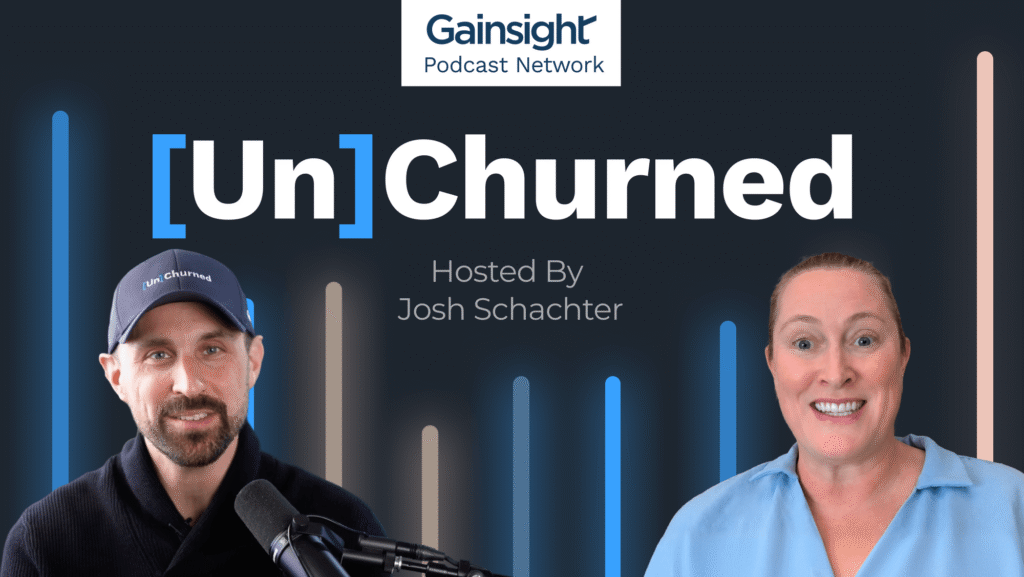
Christine Lavery, VP of Customer Success at Conga, shares why digital motions work for enterprise customers, and her 2026 priorities: product analytics and SMART goals for measurable outcomes.

166. What Happens When You Apply Digital Motions to Your Biggest Accounts? ft. Christine Lavery (Conga)
Show Notes
Christine Lavery, VP of Customer Success at Conga, shares why the traditional approach to digital customer success is broken and how she’s applying digital motions across all customer tiers—not just the long tail.
Christine discusses her two major priorities for 2026: implementing product analytics as the foundation for customer outcomes and rolling out SMART goals to move from vague value conversations to measurable impact. She also explores how AI is transforming customer intelligence by synthesizing structured data (product analytics) with unstructured data (emails, support tickets, NPS verbatims) to create a complete picture of customer health.
—
Want the playbook, not just the conversation? Subscribe for deep-dive, actionable breakdowns from every episode at unchurned.substack.com.
—
Timestamps
0:00 – Preview & Introduction
1:25 – Meet Christine Lavery
2:15 – Overview of Conga
3:05 – Conga’s acquisition of PROS and the future of CPQ
4:04 – Structure of Christine’s 100-person global CS organization
6:35 – Why digital motions shouldn’t be “long tail only.”
9:52 – Mapping customer journeys and communication strategies
13:42 – Collaboration between CS, Product, and Marketing
19:42 – Reporting to revenue and driving growth
25:30 – Breaking down the SMART goals framework for customer outcomes
27:42 – How AI fits into product analytics and customer intelligence
31:27 – Why CS leaders must fight for a seat at the table
What You’ll Learn
- Why limiting digital customer success motions to only “long tail” customers is a mistake
- How to scale one-to-many strategies across enterprise and strategic accounts
- How to use SMART goals to transform vague “value” conversations into measurable customer outcomes that clearly demonstrate ROI
- The difference between basic product analytics and sophisticated use-case tracking that helps you coach customers to better outcomes
- How AI synthesizes structured data (product usage) and unstructured data (emails, support tickets, NPS) to create a complete picture of customer health
- Why CS leaders must actively fight for a seat at the executive table
Featuring

Josh Schachter, Host
SVP, Strategy & Market Development @ Gainsight

Christine Lavery, Guest
VP of CS at Conga
Transcript
Christine Lavery:
I spent a lot of time working with my team at making sure that we, we create processes and support structure in a one to many way that can support all of our customers.
So that is like foundationally a principle that I think about a lot with supporting such a wide variety of segments within my organization.
Josh Schachter [Host]:
You’re listening to Unchurned, brought to you by the Gainsight podcast network. For years, digital customer success strategies were boxed in, reserved only for the long tail, the small accounts that couldn’t justify a dedicated csm. But Christine Lavery saw something the industry missed when she joined Conga to lead their 100 person global customer success team. She asked a simple question. Why shouldn’t our largest enterprise customers benefit from community, automated playbooks and one to many engagement too? A user supporting a Fortune 500 account still wants to know what’s on the product roadmap. They still want to learn from peers solving similar problems. So Christine is building something different. Digital success motions that span every segment, from the smallest customers to the largest strategic accounts.
Josh Schachter [Host]:
This is Christine Lavery’s story. Unchurned. Hey everybody and welcome to this episode of Unchurned. I’m your host, Josh Schachter. I’m senior vice president of strategy and Market development and at Gainsight. Very excited to be here with an industry friend, somebody that I’ve known for a few years now within the CS space, Christine Lavery. Christine is the VP of Customer success at Conga. Christine, thank you so much for being on the show.
Christine Lavery:
I’m glad to be here and it’s nice to be able to reconnect with you in this type of forum. It definitely has been a while since we last chatted, but we’ve known each other for a while and always happy to talk about the latest and greatest in the CS world.
Josh Schachter [Host]:
And you were an amazing supporter of my former startup update AI. So public praise for that. Thank you so much for all that advocacy and support. It’s an emotional topic for me because it means so much to a founder and so it’s great to. Yeah, it’s great. I love the relationships that you keep through the years. That’s one of the blessings about the customer success community. For sure.
Christine Lavery:
100% agree with that.
Josh Schachter [Host]:
So you’re at Conga now. Tell us about Conga.
Christine Lavery:
Yes. So Conga is a revenue lifecycle management software. And so for those who are unfamiliar, really living in three spaces, configure price quote. So the beginning of that revenue lifecycle journey for customers, contract lifecycle management both on the buy side and the sell side so whether you’re trying to negotiate with somebody or them with you. And then last but not least, what we call Doc automation. So many different things that we can do here. But yeah, three core pillars that we’re working on, underpinned with AI. Of course AI is the name of the game, but that is Conga’s suite of products.
Josh Schachter [Host]:
In a nutshell, you are a CPQ powerhouse, so to speak, and you’re going through an acquisition that is public knowledge. Tell us a little about that.
Christine Lavery:
Yes, we, we are going through a public. It is public knowledge, but it is an acquisition of a company named Pros P R O S. They also are a powerhouse in the CPQ world, both for their CPQ offering as well as their pricing optimization offering, which is a way to help customers as they’re trying to do their configure price and quoting to make sure they don’t like to use the definition of the product with as I’m describing it. But really it’s truly helping people optimize for the best prices not only for themselves as a company, but their customers as well as they’re negotiating. So it’s a pretty cool product and excited that it’s going to be under our belt soon.
Josh Schachter [Host]:
So that’s awesome. I mean, I don’t know about the product specifically, but I know that right now we’re in a time in SaaS where, you know, pricing is being completely restructured and we don’t know exactly where it’s going to go in the agentic world, outcome driven, so on and so forth. So sounds like a smart buy to me. You guys are, you’re about 1500 FTEs employees at Conga. You’re PE backed, you’ve been PE backed for a few years now. You’re several hundred in the. You’re in the hundreds of millions in ARR. And so what I want to do in this episode is I want to talk about your experience.
Josh Schachter [Host]:
You’ve been there for about eight months now, so you’re still kind of. Actually it’s about the same time that I’ve been with Gainsight. So we’re both still kind of just figuring stuff out. A friend of mine told me not too long ago, he’s like, you know, your first six months with the company, just shut up. Just don’t say a word. Just hide in the corner and listen. I’m like, yeah, okay, Gary, we’ll see how that goes. But we could talk a little bit about those initial experiences.
Josh Schachter [Host]:
I want to hear about like the soup to nuts that you manage for all of customer success at Conga and then we can start talking about priorities and those sorts of things. Maybe to start out like, tell us a little bit about like the structure of the CS Org that you run.
Christine Lavery:
Yeah. So I am responsible for the global CS team here at Konka and I have a team of what we call our managed CS group. You think of named CSMs supporting some of our largest accounts and strategic accounts as well. It’s not always just about spend. And then we also have a long tail of customers that are also underneath my purview as well. And then last but not least, we have our community function which really is a beautiful partnership between our marketing organization but also really helps to serve all of our customers. And then last but not least, I also have the renewals function which is a really closely linked with every single aspect of what customer success is doing. So.
Josh Schachter [Host]:
Yeah, full view, how many folks approximately.
Christine Lavery:
On my team right now around, including some subcontractors that we have around 100. So relatively large team. So.
Josh Schachter [Host]:
Yeah, it’s great. Yeah. I mean I know you from a couple years ago. Your, your size and scope has expanded. I love it. Love hearing that.
Christine Lavery:
That’s right. So I’m, I love where I am. I love Conga. I’m not just saying that. I actually really like the work that I’m doing with the team here. So it’s great.
Josh Schachter [Host]:
So okay, we’re going to make sure to, to send this, this episode to your, to your bosses. So. So I want to hear about like all the different ways that you’re. Because you’ve got all the segments, you’ve got, you’ve got Strat, you’ve got enterprise, then you’ve also got scale and then sounds like you’ve got some self service as well. This is a very broad question, which means it’s a bad question. But how are you treating those different segments differently at Conga?
Christine Lavery:
Yeah. So as most of us who have worked in a scaled situation, you obviously cannot assign a CSM to everything. So you have to think about the one to many relationships that you can cultivate with those customers. But one of the things that happened, you know, a few years ago when people started talking about like digital tech or tech touch, digital touch, whatever, is that they defined it or refined it and said, hey, we’re only going to use this for customers in the long tail. And I think that is something that needed to shift. And so one of the things that I think a lot about and I work with my team on is how do we take the concept of digital motions and drive that across the entire ecosystem of our customers. And so this is part of the reason why I enjoy having the opportunity to lead the community team because there’s so much that we surface in the community that’s not just for customers that are in a long tail space. Like a user who is supporting some of our largest customers also wants to know what are the new things that are happening in our roadmap? How are other people thinking about solving these particular problems? Like those use cases and situations aren’t just for customers in the long tail.
Christine Lavery:
And so I spent a lot of time working with my team at making sure that we create processes and support structure in a one to many way that can support all of our customers. So that is foundationally a principle that I think about a lot with supporting such a wide variety of segments within my organization.
Josh Schachter [Host]:
I love that. I mean I’ve done over 150 of these episodes and I’ve never heard that principle before. So. And it makes so much sense. I mean we talk about digital CS and community and scale, but we talk about the scale segment. We don’t talk about that for, for, you know, the larger Personas and larger buyers. I love that.
Christine Lavery:
Yes. And I mean they were like the end of the day we want our users to use our product and maximize how they’re using it. And so that is the same no matter the size and spin that you have with us. And so there’s ways that we can do that outreach and that’s what we’re doing.
Josh Schachter [Host]:
Is this something that you applied at your past roles? You were at AgentSync, you were at Typeform.
Christine Lavery:
So the ecosystems were very different at Agent Sync and Typeform. So Agent Sync was almost all enterprise, so really didn’t have a long tail function. And Typeform was almost exclusively a long tail true PLG style motion with some enterprise as they were trying to move up market. So that I think actually is what helped me is because I was having that opportunity to run both styles of motions. So then I could say, all right, there’s a perfect marriage here. Like let’s figure out how to support both and acknowledge that there are differences. Of course this isn’t a one size fits all, but like what can we do that does serve them all?
Josh Schachter [Host]:
So yeah, can we try to get tactical for folks that are listening that are like, oh yeah, no, I should be treating my, my, my enterprise segment, you know, in some ways also like the, the community and scale. What’s your playbook for doing that like, if they’re coming into this role, what, what were your steps?
Christine Lavery:
So it’s all about the customer journey mapping. Like first, like primarily that’s where it all starts. And I’m not saying because there’s different versions of like customer journey mapping. There’s the ones that are very focused on like the emotion of what the customer is feeling in that degree of rollercoaster. I’m talking about like a journey where we define what we want that customer experience to be. And it’s rooted in some degree of like, we already know what our gold standard customers look like and how they behave. So like, let’s try to reproduce that experience that they had and map it out. And so I map it at a high level.
Christine Lavery:
We’re talking like 100,000 foot level. And then we take it down to the next level and we say, okay, we identified our journey stages. What are some of the process boxes that should be accomplished within that journey stage? And then we take it down to the next level and say, all right, if you’re going to execute on this process box, what would be the templates tooling, entry, exit criteria that you would need to successfully execute this process? And so it becomes an organized way to think about each of these components and then you can communicate it out as a leader based on your relevant audience. The ICs want to know, all right, just tell me how to execute. And that’s not always 100% true, somewhat big picture as well, but like, if I’m going to like, give me the.
Josh Schachter [Host]:
Instruction manuals of the product, that sort.
Christine Lavery:
Of thing, you got it, you got it. But then if I’m talking with my peers or if I’m talking with the executive leadership team, they don’t want to know. Like, they just want to know that templates exist and they’re being useful and they’re tracked. They don’t need to know the nitty gritty details. They want to know how is it in surface of an, in service of an ultimate outcome. So you lay it out and now you can talk at the right level for the audience. So it’s impact, it’s a good, there’s.
Josh Schachter [Host]:
A point there that’s, that’s well taken in that like, because, because what you proposed doing here of, of sending potentially more communications to, to some of these Personas is if it’s not the right stuff, it’s not what maps to their interests and needs, then you’re actually starting to spam them, then you’re starting to just over index on that. It becomes Noise. So I guess there’s probably, you’ll tell me there’s a part of this process where you like really tap into the human centered design around this like mapping out the Personas and what do they really want to understand from us if we’re going to communicate with them.
Christine Lavery:
That’s exactly right. And that’s the next level. Like while we have templates, the next level that we’re doing is exactly that. Understanding the right Personas and even understanding some degree of industry specificity, you can do that when we are, when we provide a product of this size where we have these different verticals and so we can then give those target communications to say typically a customer in this particular industry is looking to accomplish xyz. Here’s how you do some of these things. And we become, like I said, more targeted in how we approach. So that’s a work in progress. But hey, I’ve only been here for eight months and we have great partnerships with our marketing team as I mentioned earlier.
Christine Lavery:
So we’re not doing like two, we don’t want to fatigue people, burn them out from our communications. We have communications calendar so we can be well coordinated on all of that. So it’s a, it’s a becoming a well oiled machine is what I would say.
Josh Schachter [Host]:
No, this is really interesting and by the way, we didn’t prep this earlier that we were going to go in this direction but I love it because you know, I’m leading our corporate marketing at gainsight and our customer marketing, our advocacy. And so this is really interesting because the first thing that’s going on in my mind now as you’re talking about producing all this content that’s, that’s based on the different segments and you know, wrapping that up in scale is okay, but we have generative AI. But like now I need to create a factory of content. I need to create a machine to feed all that different content. So, and that feels really intimidating to me especially if I’m like maybe if I’m in a, in your shoes, you’re not even on the content side, so to speak. Right? Like, I mean maybe you are but like so, so how do you, yeah, like how does that work? How do you make sure that, that you’ve got the right content and the machine is well oiled.
Christine Lavery:
So I think, I know I said, oh, I’m not in the content side. I do have a small component of it within the community. And, and, and there are some degree of outreaches that we have just like raised our hand and said hey, we’re going to own this. We want to take this because we’re the ones who are trying to be consuming some of this data related to product analytics, which we can talk about that in a little bit. But we are consumers of information about how customers are using our products and therefore we can put like that CS lens on it as well. So. So we do create a little bit of that. But I think what’s the role, what’s.
Josh Schachter [Host]:
The role that creates that within your team?
Christine Lavery:
I have, I have content individuals. They roll up through my digital success leader. I have both a community team as well as an individual who does content. So I don’t know her exact title, but she’s partnering literally day in and day out with the folks in marketing as well. But she’s also partnering with our folks on the support team and professional services just to make sure that everything is ticked and tied with all of that. So yeah, so hopefully she won’t. That I didn’t 100% know her title, but she’s amazing.
Josh Schachter [Host]:
That’s fine. Titles are meaningless, right? It’s all about the work that they’re producing. It sounds like she’s doing good stuff. So how is she keeping it in check with. With. With product marketing? With. Or maybe she is product marketing, but with. With what product is releasing and.
Josh Schachter [Host]:
And what’s going on with Proserve, like cross collaboratively.
Christine Lavery:
So that is the, the PMM work is actually an evolution that Conga is undergoing right now as well. And we have done as. As somebody who at the end of the day, like I want our customers to be renewing, of course, like that’s name of the game with customer success, but it’s like I want to make sure that when PMM is creating particular collateral that not only my teams can end up being enabled on or that we can share with customers, that we actually have a seat at the table with this. And so part of that seat at the table isn’t just like us saying, hey, we need help in terms of how we’re being enabled on it. It’s also saying in the content space, all right, you guys have created this, we can evangelize this in our different channels. We have the community that we can evangelize it in. We have the right playbooks that we can run in terms of automated call to actions, et cetera, where we’re surfacing some of the stuff that PMM is creating, et cetera. So I guess to shortly to summarize it, like I’m making sure and driving my team to have A seat at the table so that we’re included in all of those conversations.
Josh Schachter [Host]:
Yeah. How are you executing these communications at scale?
Christine Lavery:
So we are using Gainsight cs. So you may not have heard.
Josh Schachter [Host]:
Okay, good. I was hoping you were going to respond that way, but I wasn’t sure. I mean I know you guys are a Gainsight CS customer, but we didn’t talk about that before, so. Okay, good. Nailed that one.
Christine Lavery:
We’re using Gainsight cs. There are things of course, that we’re partnering with the tool that the marketing team is using. We’re also using Gainsight’s community for the one to many approaches. We do webinars, we do recorded webinars, et cetera. And we’re in the middle of evolving it. So I should say we’re not live on Gainsight community yet, but we’re targeting it to go live with our customer event here in March. But we have all of our. I sat in a workshop at the end of last year with the flows of everything that we’re building out with the community to drive more engagement there, more attention in the community, et cetera.
Christine Lavery:
So. So yeah, we’re getting, we’re not perfectly well oiled yet, but we’re getting there.
Josh Schachter [Host]:
So yeah, you’re warming up to it. How is or how will customer success work with marketing on that community effort?
Christine Lavery:
So hand in hand. So there are. It’s funny, depending on who you talk to in the industry, there’s a lot of opinions around where communities should live.
Josh Schachter [Host]:
That’s why I asked the question. Yeah. Because I’m hearing a lot of that difference of opinions.
Christine Lavery:
Yeah, well. And you can think of community as a way to do like account based marketing of course and other levers in terms of attracting new logos. You can use it as an inbound channel on that demand gen side and I have a feeling we will end up getting there. But right now we’re really using it as a place to drive collaboration with our customers and answer questions that come up, talk about the roadmap, et cetera. But really like there’s no reason that our community can’t be a place in the future for inbound demand gen as well as servicing our customers and creating this vibrant place of collaboration. I mean that’s ultimately where we want to go. So we’ll get there.
Josh Schachter [Host]:
Yeah. Work in progress.
Christine Lavery:
Yes.
Josh Schachter [Host]:
When you first joined, you reported to the chief customer officer.
Christine Lavery:
I did.
Josh Schachter [Host]:
Now you report to the CRO and other folks that were reporting to the cco, like head of Proserve and support. They’re reporting to the coo.
Christine Lavery:
Correct.
Josh Schachter [Host]:
So what’s that transition been like for you?
Christine Lavery:
So for me it’s been, I’ve enjoyed it. So not because I didn’t enjoy the previous leader. It has nothing to do with that. It’s I think about where does Conga need to go in this phase of our journey? We talk in general about there’s a time and place for certain profiles of individuals to be leading certain organizations and meeting them where they are in the, in their moment. And right now conga is in a like we need to drive growth moment. And so I hear our CEO talk about this. And so if you think about like economically, where do you get the most amount of growth at the lowest acquisition cost? It’s within your existing customer base. And so that’s why for me it makes complete sense for the customer success organization to report into revenue so we can be partnering more closely on the cross sell, upsell, farmer type motions that need to be happening within our install base and drive that growth.
Christine Lavery:
So this is the moment that Conga is in. And so I think this makes complete change or makes complete sense to have made this change for the organization.
Josh Schachter [Host]:
So give me an example. Give me if I’m a fly on the wall inside the office of Ganga, what would I see maybe differently between six months ago and today with regards to commercializing the team?
Christine Lavery:
So it’s a really good question. We’re still in the midst of this transformation, just being completely open there. But one of the things that I’ve done within my team, and we actually just had an amazing, amazing training session this past week is we focused on learning and talking about what does value look like to our customer and how do we have the right conversations with that customer so we can ultimately measure their outcomes. So people are buying your software to accomplish a goal. And so what you will see here is the types of conversations that we’re having with our customers are shifting to be outcome driven, more business savvy. So we’re connecting how conga actually supports a business’s like root goals and not just a, oh yeah, you’re a platform that. Or a product that’s doing some stuff for us. And so we’re on this evolution and that’s the big change that has happened since I joined.
Josh Schachter [Host]:
I love that.
Christine Lavery:
Let me clarify a little more because you’re like, what about the commercial aspect? And so, um, those are leading indicator behaviors that are going to, to lead to lagging indicator results in the form of better retention at the end of the day. And I’ve done that a handful of times. So I know that this is where we’re going to end up going and it’s going to be great.
Josh Schachter [Host]:
What I really like about that is we had our like CXO summit a couple months ago with gainsight, with, with CCOs and leaders and one of the, like, the insights, at least for me that came up, that I was, was, became aware of, was it is so important now in this world of AI to have more strategic conversations, human conversations. We’re not quite at the digital twin yet for that, but human conversations with your customers that actually extract the most value from those conversations about the value that your company can provide. Because without extracting that information and that intelligence, the AI actually can’t act on anything or without, sorry, without extracting the data from the conversations, the AI can’t give you the intelligence and synthesis and help you track it and monitor it over time. Right. So like our people need to become better operators. Not that they’re not good operators currently, but need to become like real pros at, at conducting these conversations with our customers so that we know exactly what the needs and the goals are.
Christine Lavery:
Yes. And it can be challenging when you haven’t done it before. And so that’s something that like I’m focusing a lot of energy with my team on. I mentioned we did this training slash bootcamp last week and that was kind of the introduction to the concepts in a more live training style setting. And then we’re going to continue to do enablement, continue to do practice and role playing, et cetera, so we can become more comfortable. And I can, I’ve already seen myself where even though we’ve rolled out the principles for a while now, I’ve already seen some of the progression and development from, from some of the team members and conversely, when I’ve jumped on calls with customers and I talk with them about this type of approach and the importance of us understanding truly what value is. You get a lot of nodding and you get a lot of like, yes, that’s what I need. That’s the story that I want to tell too.
Christine Lavery:
And so it resonates with them too. Sometimes customers just don’t even know that that’s what they need to be asking for help to do. And so we have to be able to advise and lead them there.
Josh Schachter [Host]:
Yeah, yeah, we are still in the new year, so to speak. It’s hard to believe we’re almost like a tenth of the way into the year. But what are some of your big rocks now that you’re approaching in 2026.
Christine Lavery:
Yes. So I have two, two really big ones within MySpace. So the first one is around product analytics and the second one is around smart goals. So I’ll start with the second one because it kind of relates to what we were just talking about. So smart is an acronym and so.
Josh Schachter [Host]:
Are you going to spell out the acronym for us? I know, I know you, I could see you struggling to think through it now. Look it up.
Christine Lavery:
Yeah, I can’t remember the S. I can never remember the S, which is crazy. Measurable, attainable, relevant, time bound and then the S. But the point of this is it’s an acronym that by the way, thank you. Thank you.
Josh Schachter [Host]:
Thanks Google.
Christine Lavery:
Maybe it’s one of the most important ones. We don’t want to be vague about our goals. Right. So this is something I actually rolled out with the team a few months ago, introducing the concept and starting to train on it, et cetera. But now we’re really diving in and really focusing on this because to be able to, going back to what I was saying, to be able to understand in the smart framework what a customer wants to accomplish and then be able to actually measure it for them, it makes it really easy to say yes, we did it or no, we didn’t. It takes the vagueness out of did I get value from Conga’s products? Well, we defined that these particular goals were really important to you and we absolutely nailed it on these three or we didn’t. And then it’s like, well, why didn’t we? And that’s, you know, a conversation in and of itself. But by doing this, it’s a leading behavior and it’s a leading indicator that will ultimately get to results.
Christine Lavery:
And that’s, that’s why I have so much focus on this. Semi related to this is product analytics, which is also important to the AI space as well. But we like again, if customers aren’t using our product, then they aren’t going to get value for one. That’s like the basic use case for product analytics, but the more complex or sophisticated ones are around what’s the use case that a customer should be using our product for and are they using the features associated with that particular use case. And if the answer is no, then we can advise them on how to use the product in a way that will help them get to their outcomes. And I can’t do that unless I have the right product analytics to help me tell that story. And so thankfully a lot of cross functional collaboration at Conga on this. So while it’s A big rock for me.
Christine Lavery:
A lot of focus across the org on it as well. And that feels really good and it feels really productive because again, leading indicators. If we know how customers are using it, we can coach them to use it better and they’ll be happier, they’ll see results and they’ll stay. So it’s all interwoven together.
Josh Schachter [Host]:
Do you see AI as being a part of this journey for you?
Christine Lavery:
I do. So AI is super important as well. It underpins all of everything that we’re doing. So AI has, as we’ve all experienced, has evolved a lot of. So I think of it in two buckets. I think of it in terms of the structured data. So the product analytics, for example, there’s numbers, yes, no binary, black, white, whatever. And then there’s the unstructured data, what is coming through in email communications, what’s coming through in support tickets, nps, verbatims, et cetera.
Christine Lavery:
There’s so much information that’s sits in these unstructured conversations that AI today can help us start to extract and pull together a full picture of a customer sentiment. Or it can say customers are consistently talking about this particular feature isn’t great. And we can pass that to our product teams. And it’s not just product, by the way. There’s so many things that we can synthesize, create paretos around that we can share with the organization once we have this AI view of what’s happening with our customers. So really excited about where we’re going with this and how we can then build calls to action. CTA’s digital plays we were talking about earlier bring this all back around once we have these really amazing insights from AI and I know it exists. I have seen some really great examples of how this is happening and excited to use it soon here at Kaga.
Josh Schachter [Host]:
Cool. Cool. Yeah, I mean we, we did our gainsight agentic connect roadshow tour in the fall, went to like 10 different cities and had. Were you at one of them? I think one was in Colorado. You’re in Colorado.
Christine Lavery:
There was one. I was unable to attend. I tried, but it just wasn’t going to work out with the timing.
Josh Schachter [Host]:
But that’s okay, that’s okay. I’m not holding against you. But, but it was funny because like, like we had people form groups, leaders form groups and ideate around like the ideal magic wand solution through AI for their teams. And pretty much everything came back with like customer intelligence synthesis. Customer intelligence synthesis across, you know, NPS and email and, and, and zoom and all the different channels. And of course we were like, yeah, like, amazing. Like, let us introduce you to Staircase AI. But, you know, so.
Josh Schachter [Host]:
But. But definitely that’s something that I hear from a lot of leaders.
Christine Lavery:
Yes.
Josh Schachter [Host]:
Okay. One final takeaway from you for leaders that are listening out there that if anything, you’ve learned through the last eight months in your transition to this, this great role that you have at Conga.
Christine Lavery:
The. The one thing that I have learned, maybe it’s. Maybe it’s not a new thing, but I think it’s a reinforcement around the impact that CS truly can have on organizations for customers. Sometimes is so, like, understated and underrepresentative. Underrepresented. Excuse me. And so as leaders, like, we know what our customers are saying and we need to make sure that we have a seat at the table to share those insights and be drivers of what, like, being truly customer first and customer centric looks like for organizations. So I could spend probably a whole nother podcast on that topic in and of itself, but that I think remains true.
Christine Lavery:
I’m fortunate that Conga, like, is customer first in how we’re approaching a lot of things, and there’s a lot of value and emphasis on the CS function here. I’m grateful for that and I think that’s why it’s like, it’s resonating with me because so much of what I’m hearing from other people is not the experience that I’m having here at caga. And it’s good for my organization, but it just validates, like, we need to keep being voices of our customers. You can’t, like, take the pedal off that.
Josh Schachter [Host]:
Yeah, well, I can hear the energy in your voice. You found a really great home with Conga, so congratulations on that. Congratulations on your own growth, on the growth of the organization, and again, thank you for being a friend in the industry, for all your past support with our initiatives as well. Christine Lavery, VP of Customer Success at Conga, thank you so much for being on the show.
Christine Lavery:
Yes, thank you for having me. Great to chat shop with you. Always love it. So thank you.
[Un]Churned is the no. 1 podcast for customer retention. Hosted by Josh Schachter, each episode dives into post-sales strategy and how to lead in the agentic era.
Browse Series
Subscribe on