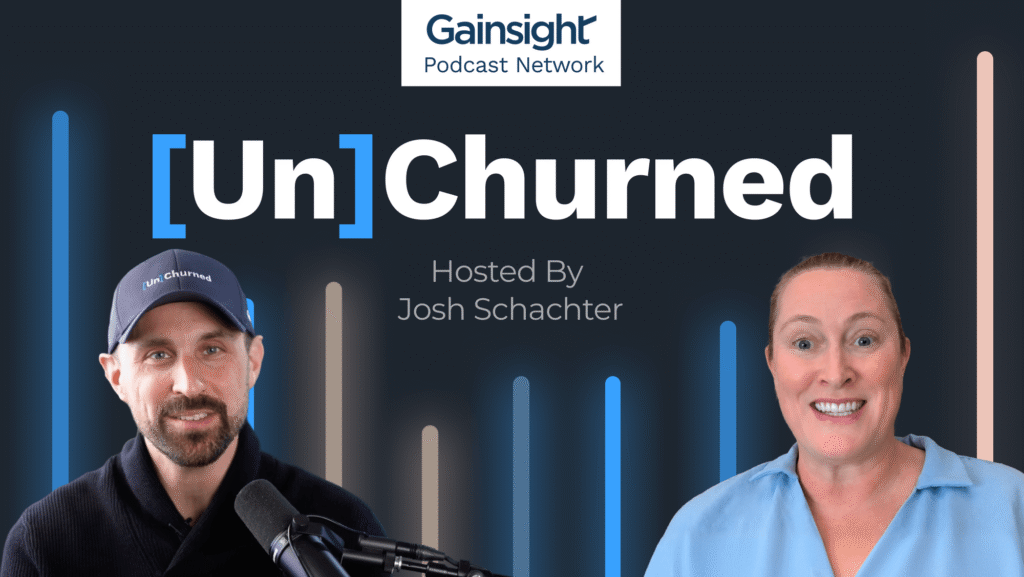
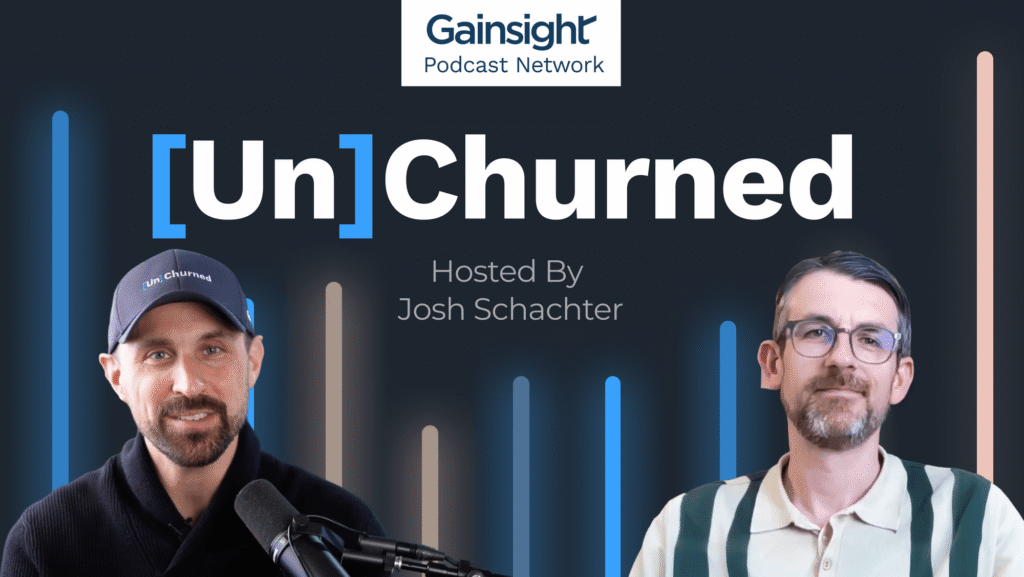
Amanda Moran of Darktrace on rebuilding digital CS for the agentic era, serving 10,000 customers with a team of five, and the in-between playbook.

198. The Old Playbook Is Obsolete. The New One Isn’t Built. ft. Amanda Moran (Darktrace)
Show Notes
Six months in, Amanda Moran, is rebuilding customer success from scratch.
She spent eight years at LinkedIn mastering the old playbook: rules, workflows, perfectly timed emails. Now she’s VP of Digital Customer Success at Darktrace, a cybersecurity company betting its future on securing AI itself.
But she’s stuck on the question keeping every CS leader up at night. Autonomous agents aren’t here. You can feel them coming. So what do you build right now, without wasting months on work the agents will replace?
Josh Schachter pushes into the hard parts: the data nobody connects, and why the next cybersecurity battle is the AI you’re about to deploy.
This one’s for anyone building toward a future that hasn’t arrived.
—
Want the playbook, not just the conversation? Subscribe for deep-dive, actionable breakdowns from every episode at unchurned.substack.com.
—
What you’ll learn
– Why rules-based outreach is on its way out, and what comes next
– How to build CS today without locking in throwaway automation
– The pooled support model behind 5 people serving 10,000 customers
– Why agentic AI is cybersecurity’s next frontier
– The hidden signals in community and learning data
– What CS leaders are all quietly trying to figure out
Timestamps
0:00 – Preview & Introduction
1:42 – Meet Amanda Moran & Overview of Darktrace
3:00 – Transitioning from LinkedIn to cybersecurity
4:03 – Building AI-driven email engagement
6:50 – The Digital CS org at Darktrace
9:20 – The pooled model
11:39 – Renewals at Darktrace
12:45 – Securing AI itself: the July launch
14:17 – Internal AI enablement
15:17 – Building CS before the agents take over
17:50 – The data problem
20:10 – The in-between phase nobody has cracked
Featuring

Josh Schachter, Host
SVP, Strategy & Market Development @ Gainsight

Amanda Moran, Guest
VP, Digital CS @ Darktrace
Transcript
Amanda Moran:
If we can connect everything we know about a customer and then have an agent that can identify are they at risk based on multiple factors and can develop an outreach for that customer and know when to deliver it and what’s the right channel to get it to that customer?
No, I think that version of digital outreach will be here at some point, but that’s not the version right now. But also how do we think about building something that is not going to be sort of the manual version of scale and we don’t get kind of baked into a lot of manual automation when we really want to be building towards this future version.
Josh Schachter [Host]:
You’re listening to Unchurned, brought to you by the Gainsight Podcast network. There’s a moment in customer success right now where the old playbook is almost obsolete and the new one isn’t quite built. Amanda Moran spent eight years at LinkedIn perfecting the old way rules, workflows, perfectly timed emails. Now she runs Digital CS at Darktrace, a cybersecurity company whose next product secures AI itself. And she’s sitting with the question that a lot of us are as well. What do you build when autonomous agents aren’t here yet, but you can feel them coming. I’m Josh Schachter. This is Unchurned.
Josh Schachter [Host]:
Subscribe to our substack@ Unchurned.Gainsight.com where we go deep on every episode. Like how one post sales team at Cloudbeds built over 150 AI agents. That story and more at Unchurned.Gainsight.Com hey everybody. Welcome to this episode of Unchurned. I’m Josh Schachter, senior Vice president of strategy and go to market development at Gainsight. I’m very excited to be here today with Amanda Moran. Amanda is the Vice president of digital customer success at Darktrace. Fairly new in the role still in the first six months and prior to that she was around eight years leading digital CS at LinkedIn.
Josh Schachter [Host]:
Amanda, thank you for being on the show and welcome.
Amanda Moran:
Thank you. Thanks for having me.
Josh Schachter [Host]:
Tell us darktrace is a great company for those that may not be as familiar. Tell us a little bit about what the company does and then let’s just talk about your remit and your role in Org.
Amanda Moran:
Yeah, great. So darktrace is a cybersecurity company. We have been around for about 13 years and Darktrace uses AI to provide cybersecurity for companies. So Darktrace’s AI is cyber self learning behavioral AI that is designed to understand what is normal on a company system and then identify novel threats that come in that they wouldn’t have been able to see otherwise.
Josh Schachter [Host]:
Was that a transition for you at all? Going from LinkedIn, which is not cybersecurity, although my LinkedIn account has been hacked a couple times. But going from that to going into darktrace and in the security world because security is a big software industry out there and I speak to a lot of CS leaders within the cybersecurity domain. But you didn’t come from that background. Tell me a little bit about how that’s been.
Amanda Moran:
Yeah, that’s. Well, that has been an interesting transition. It’s definitely different. It’s a different, obviously different product, a different kind of customer. So there’s been, you know, there’s been a lot for me to learn in terms of how we can use because I was coming from building out digital CS and I’m looking to do some similar things things at darktrace but thinking about how similar kinds of scaled and digital programs can work for a more technical audience and a very different kind of product. So it’s been interesting. But the AI focus that darktrace has is perfectly situated for looking at how do we build out scale and AI based customer engagement. So I think that’s a really exciting opportunity.
Josh Schachter [Host]:
Yeah, good for you to have the growth mindset to go into something new. I’m sure when you say interesting, it’s a euphemism for a little bit of a challenge, a little bit of something new. So kudos to you for that. Before we talk more about darktrace, what’s something that you’re really proud of that you built at LinkedIn?
Amanda Moran:
There were a number of things. I think one thing that I was really proud of was it was a big cross functional initiative that my team was a part of that we built out in looking at how do we think about using sort of AI based engagement for customers and making more personalized email engagement specifically. And so we built a system where we had a model that looked at customer data in terms of how they were adopting the product, looked at best practices in the product, looked at how peers were adopting the product, and then generated personalized emails that gave customers next best action recommendations that were tuned for them specifically and then sent that out and sort of iterated on that looking at how do we make it more efficient, how do we make it more personalized, how do we have a better impact? So that was something that I was proud of that we were able to. And this was a while we started this probably back in 2023. And so the fact that we were able to kind of experiment and get to a model that that was having more personalized scaled engagement was, was exciting and fun.
Josh Schachter [Host]:
Do you remember the impact of those efforts?
Amanda Moran:
We, we, we saw a number of different, you know, we went through a lot of iterations and so depending on the product and the, the iteration, it was having different impacts. But one of them in the early stage, one of the things that we saw was that of customers who engaged with 30% saw an increase in one of the features, one of the three features that we were recommending to them. So that was that which was our key, the key impact that we wanted to have was getting them to do better with their product engagement wherever they were, whether they were beginning or if they were an advanced user, how could we get them to take that next step? The other thing that we tested it on was customers who were not engaging at all to see could we get those disengaged customers to come back to the product and use it more. And we saw a, a 10% uplift in customers who hadn’t been coming in at all to getting them back in the product, which we saw as significant because they were customers who were. Those were either customers who were at increased risk of churn or seats on contracts that would have been at risk if those customers weren’t using the product.
Josh Schachter [Host]:
Yeah. So this was. Were you guys using Journey Orchestrator or
Amanda Moran:
something else that we were, we were using Journey Orchestrator and yeah, so that was.
Josh Schachter [Host]:
Okay, cool. I didn’t know we were going to go into that. But that’s really cool to see the results of that to show how to do the digital thing successfully. So now you’re at darktrace. You’re running again digital CS at darktrace. What is the setup of the. Org? Usually I would ask, you know, tell me about your different segments. In this case, we’re going to go straight into the digital segment.
Josh Schachter [Host]:
What does that segment look like at darktrace and what does your team orchestration, your team layout, composition look like?
Amanda Moran:
The so far what we have is a. We have, we have a team that has, we have Lifecycle program managers and so they’re going to be focused on. And I’m building the team right now. So this is sort of happening live, but we’re building out Lifecycle program management where we will have program managers who are focused on different phases of the customer lifecycle so that they are looking at what is that customer experience lens on everything that’s happening in that phase. And Some of that is customers have multiple products with darktrace. So we want to make sure that we are looking across everything that they’re engaging with and how are they receiving information, what are their needs at different phases and making sure that it’s all orchestrated between all the different people and eventually agents that they might be talking with in that phase. So that’s a key part of the team. We’re also building out a customer community, so we’re getting ready to launch within the next couple of months.
Amanda Moran:
A community. So we have a community program manager who’s come on to build that out and expand that in the next year. We are also, we, we work very closely with a partner team that is responsible for the data end of everything that we’re doing, making sure that we’re getting the product telemetry that we need and that we have clear signals to operate on so that, so that we know at any given point that we are reaching out to customers with what they need most.
Josh Schachter [Host]:
Yeah. Wow. Wonderful, wonderful. And, and so how big is your team right now?
Amanda Moran:
I know you guys are growing right now. It is about. There are about five people who are dedicated to driving the digital. Yeah. And then we’re looking at what we will need as we expand.
Josh Schachter [Host]:
How many customers is that group supporting?
Amanda Moran:
Well, the way that we’re looking at it, so Darktrace has roughly 10,000 customers. We are looking at how we can support different segments within that customer base. But I see the digital program as being foundational for all of our customers. So for example, the customer community is going to be important for the larger customers who want to engage with peers. But it’s going to be especially important for those smaller customers who might not have as much hand holding and one to one engagement as the larger customers. So there will be parts of it that are foundational, parts of it that we target towards customers in a particular segment. But that’s where we’re starting from.
Josh Schachter [Host]:
What does your engagement model look like then with the other segments of CS and with the other leadership so that can become foundational across the different segments.
Amanda Moran:
The model that we’re building out is for a certain segment of the customers and we’re figuring out where it makes the most sense based on the complexity of their deployments. But for a certain segment it will be digital first. So we are making sure that we are engaging with them, getting all the education and the product notices that they need. And then there will be a pooled model where we’ll have three, basically three different teams that we pull in Depending on what the customer need is. So there’s a CSM team that will be able to come in to talk about value or to talk about usage issues. Another team that’s our customer success engineering team that comes in for technical issues. So we’ll be able to call up that team and then of course our support team that deals with break fix issues.
Josh Schachter [Host]:
And the customer success engineering is that, that’s not FTE motion is,
Amanda Moran:
is right now.
Josh Schachter [Host]:
Yeah, it is. Okay. Yeah. Everybody’s got their own version of it, you know, calling it different things. There’s this evolution. But so, so you’ve got your, your value arch. It’s funny because these are the three like themes that I’m hearing across the different archetypes of, of CS these days of CS managers is you’ve got your value architects. This is the people that are just like.
Josh Schachter [Host]:
That’s a theme I hear is everybody wants like we need to become more outcome driven, more value focused really to drive those things. Then you’ve got your fdes or your customer success engineers and then, and then you’ve got the folks that are managing at scale and you know, leveraging the types of tooling that you’ve identified.
Amanda Moran:
Yeah, yeah, yeah. And then the one other layer on there is that there is a sales team that’s focused on any commercial issues that crop up in the middle of the lifecycle for the customers within this segment. So that’s the other, the one last piece of it that we’re coordinating closely.
Josh Schachter [Host]:
Does CS own any revenue within the org?
Amanda Moran:
CS owns the renewal, basically. So there is, so the renewal targets are owned by CS and there’s a renewals team that comes in at the end of the life cycle. So that is the. Once we get through that middle part of the lifecycle where we’re running digital first and handing off to these pooled teams, we hand off to basically the renewal manager who comes in and makes sure that the contract gets signed and answers any questions that customers have at that point.
Josh Schachter [Host]:
Yeah. Do you have any unmanaged renewals at the Super Long Tail?
Amanda Moran:
We don’t yet. We are looking at what can we. Right now we’re just standing up our first renewals outreach campaign to try to make some of that a little more seamless. And I think ultimately if there are renewals that we can, that we can fully automate to make it easier for the customer and the renewals team, that’s what we’re, we’re hoping to get within the next year some version of that stood up. Yeah.
Josh Schachter [Host]:
Let’s talk about AI. You guys are launching new AI features within the products. You’re like you said, you’re an AI first company. Now, I’m assuming that’s a newer thing. 13 years ago that might not have been the case. Maybe it was.
Amanda Moran:
It was always the case, actually. Yeah, it was, yep. The team that built darktrace and it’s a team out of the UK in Cambridge, they were early, sort of early builders of AI. So it’s always been AI first.
Josh Schachter [Host]:
Oh, that’s amazing. That’s amazing. What’s the most exciting stuff around AI going on right now? We’re in Q2 of 2026.
Amanda Moran:
The most exciting thing is that the product team is rolling out a new focus on securing AI itself. So the darktrace up until now has had products that secured companies across all the different surfaces that they had, whether it was network or email or cloud. But of course, the, you know, agentic AI as something that we are all using and that all businesses are now figuring out how we’re going to use it is sort of the newest space that companies need help securing because that creates a whole new layer of risk and, you know, people operating on agents, agents operating on their own. And so securing AI itself with, with that agentic layer is darktrace’s focus starting in about July.
Josh Schachter [Host]:
I love that. That’s. That’s awesome. That’s gonna be a fun journey for you guys and I think a very fruitful one as well. Lots of companies that are struggling with that and thinking about it.
Amanda Moran:
Yeah, yeah.
Josh Schachter [Host]:
What about internally, as far as your own AI enablement, how are you approaching that right now for your team?
Amanda Moran:
Well, there are a couple of things we’re doing. So one thing that we’re doing is just everyone is using agents individually. I think there’s a lot of cross team support of just testing it out and kind of openness about with everything that we do, did we see if we could do it more efficiently or smarter using agents? We also have an AI or an agentic tiger team that is launching to coordinate the way that we’re developing agents across the business. Because that’s one. As we move into this next phase of how we work, how we work internally, how we work with our customers, figuring out how do we coordinate all of that so that we are surfacing needs, connecting different agents and orchestrating all of that work is going to be critical. So this AI Tiger team is starting to make sure that we’re doing that in a coordinated way.
Josh Schachter [Host]:
How are you starting to use AI in Your role?
Amanda Moran:
Well, in my role, one of the things that I am thinking a lot about is what’s the near term agentic possibility for digital cs? And then what do we want to get to in the, I mean, a year from now, which I don’t. That’s still like, that seems somewhat far away right now, but it’s still far fairly. It’s going to come very quickly. So I think the, the way that I’m thinking about it is how do we, how do we create what, what’s available right now? How do we create the system that is going to support our customers, that is going to help us efficiently make sure that they are getting value from the product? And, and what role do agents play in that? What, what version of agents do we have today where we could stand something up that would make life easier for customers, but how do we think about that in terms of what’s the version a year from now that is going to just make it a lot more instantaneous, a lot smarter? So I think that the thing that I keep thinking is if we can connect all of the data that we have about our customers across how they’re using the product, across our contract systems, across all the communications that they have with our teams, including how do they use the community, what are they doing in our learning center? If we can connect everything we know about a customer and then have an agent that can identify are they at risk based on multiple factors that right now maybe we don’t even have the bandwidth to identify what’s the combination of factors that would identify risk. But an agent can see it and can develop an outreach for that customer and know when to deliver it and what’s the right channel to get it to that customer. I think that version of digital outreach will be here at some point, but that’s not the version right now. What pieces of that might we be able to put in place? But also how do we think about building so that we’re building something that is not going to be very, you know, sort of the manual version of scale and we don’t get kind of baked into a lot of manual automation when we really want to be building towards this future version?
Josh Schachter [Host]:
Yeah, you know, it’s fascinating. I mean, we have our digital customer hub, our digital CS side of the business skill jar and our community product. And I’ve never actually thought about that, that you can use people’s participation in the community, what they say, and the things, you know, the flows that they’re going through and certifications or any speed bumps on the education side as signals in a health score and to understand where somebody is in their journey. So that’s kind of cool. It’s the first time I had thought about that and thank you for bringing that up to me, Amanda.
Amanda Moran:
Yeah, yeah, yeah. I don’t, we haven’t. I mean that was something that we had not quite in my team at LinkedIn. You know, we had connected a lot of things by the, you know, we had built out the digital and skill program that we had there over all those years, but there were still things that were not yet connected in the background. And I think that is the piece that as we look at digital and as we look at agents, the manual, in a way, first step, I think is connecting all of those data components. And I think there’s, there’s so much possibility behind some of the things that customers are doing in our systems that if we can figure out how to connect that all, it’s just it, it gives us the opportunity to have that much more of a personalized engagement with that customer.
Josh Schachter [Host]:
I mean, I totally agree it all. Last year the buzz term was prompt engineering. This year it’s context engineering. It’s all about feeding it the context and putting all that plumbing together. Like you’re saying.
Amanda Moran:
Yeah.
Josh Schachter [Host]:
Now any, any, any speed bumps that you’ve, that you, that you’ve had to, to power through, whether it relates to AI or otherwise, setting the foundation of the organization now in your first few months.
Amanda Moran:
Well, I think there are, I mean I, I think there are a lot of things for us to work through. I think this, like the data piece is, is something that we are still working through and that I think will probably be, you know, I think we’ll have to approach it in a, like, in a phased way in terms of getting core components together and then adding in these pieces, like figuring out how do we pull in community engagement into what we’re seeing about a customer. So I think that’s one of the foundational things that we’ve been working through.
Josh Schachter [Host]:
What would you want to learn from other leaders in a similar seat about what they’re doing with their groups?
Amanda Moran:
That’s a good question. I think there are lots of things. I think the one thing that I’m curious about is how are other leaders approaching this step, this kind of in between phase where we don’t want to be building out all of the sort of rules based outreach that we used to have. But maybe we’re not quite at the point of having agents that can operate as, as sort of limited Autonomous people. I don’t want to say people, because I think we will still have people teams. So it’s not that agents are replacing people, but, you know, maybe we’re not at the point of having autonomous agents. So what’s the. What’s the in between step and how do we.
Amanda Moran:
How do we use AI to make the outreach more efficient, more personalized while we’re on this path to having agents who can be sort of part of the team?
Josh Schachter [Host]:
It’s funny you should say that. We have got Gainsight has something up its sleeve along those lines. We’re recording this. It’s not going to go out for a month or so. So I think I can tell it to you or I can kind of suggest it right now. By the time this episode airs, I think it’ll be out there. I’ll tease it for now because I think that there’s a lot of other folks that are at a similar place. I think we’re in this.
Josh Schachter [Host]:
Because I think we’re in this transition state where like two years from now, you know, whatever, two, three years from now or five months, who knows, the agentic stuff will be fully autonomous. You’ll just be able to, like, you know, press, go, turn on, and it’ll do everything. But I think now you’re right. There’s this state where it’s not quite there yet, understandably, but you also don’t want to waste your time. Waste your time, you know, but you also don’t want to be. Yeah, wasting. Let’s say it, wasting your time configuring workflows like you used to. And so I think there’s.
Josh Schachter [Host]:
There is a model out there for like, the in between.
Amanda Moran:
So.
Josh Schachter [Host]:
Yeah, we’ll leave it at that for right now. Yeah. Amanda, this was great. Thank you so much for being on the program. Vice president of digital Customer success at darktrace. This was wonderful, and we’d love to have you back in the future.
Amanda Moran:
Great. Thank you so much.
[Un]Churned is the no. 1 podcast for customer retention. Hosted by Josh Schachter, each episode dives into post-sales strategy and how to lead in the agentic era.
Browse Series
Subscribe on