Why Okta bans its CS team from selling. Chael Banks on AI in customer success, value realization, and scaling trust across 20,000 customers.

188. Here’s What Happens When CS Teams Cross the Commercial Line ft. Chael Banks (Okta)
Show Notes
Everybody can build with Claude now, but nobody figured out the responsibility part yet.
Chael Banks runs customer success at Okta. 20,000 customers. Billions of logins a day. In this episode he breaks down a hard rule: his team will never sell. Ever. Why? Trust. In identity security, trust is everything.
The moment money becomes the motive, the relationship tarnishes. Chael draws a sharp line between commercials and consulting. His team carries the value narrative instead. He also gets real about the AI supernova. Too much building, not enough consolidation. He shares how Okta uses AI to make people more effective, not just efficient. Plus: the identity maturity model, value realization at scale, the long-tail digital motion, and a personal story about Lane 6 that shaped how he leads.
What You’ll Learn
– How to split selling from guiding without losing revenue
– Why trust beats commission in high-stakes industries
– How AI makes junior reps sound senior
– The identity maturity model as a value framework
– How to scale one consistent conversation across all customer segments
– Why efficiency only matters in service of effectiveness
– How to run value realization without renewal panic
– A leadership lesson on grit from Lane 6
—
Want the playbook, not just the conversation? Subscribe for deep-dive, actionable breakdowns from every episode at unchurned.substack.com.
—
Timestamps
0:00 – Preview & introduction
1:30 – Overview of Okta & inside their CS org
4:08 – Everyone is building with AI. Now what?
6:00 – The identity maturity model explained
9:03 – Customers DO NOT want salespeople & why Chael’s team will never do commercials
13:30 – What’s working at OkTa with the 20% AI transformation
17:15 – Okta’s long-tail digital motion
20:10 – Value realization: the train analogy
24:00 – Big rocks at Okta & Chael’s message on AI & jobs
28:10 – Lane 6: grit, persistence, and leadership
Featuring

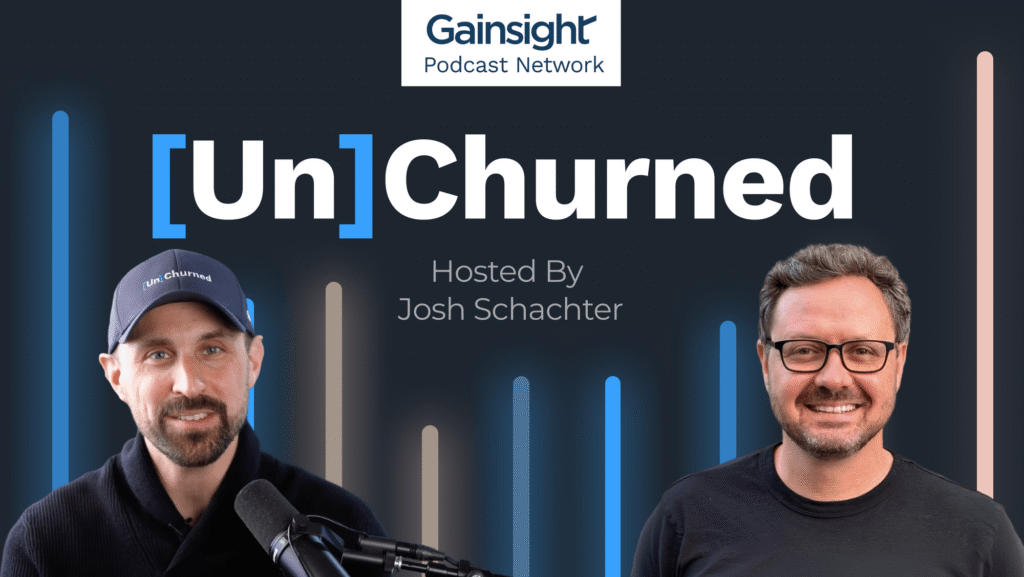
Josh Schachter, Host
SVP, Strategy & Market Development @ Gainsight

Chael Banks , Guest
SVP of CS @ Okta
Transcript
Chael Banks:
The worst thing that can happen is that is you get to an output time and you’re going to launch and you’re previewing with somebody to do testing. Client says, well, that’s what I said. That’s not what I meant. And I expected you to figure out what I really meant.
Customers want to buy from tour guides and not taxi drivers. They want people to lead them through and tell them what’s right because everybody’s scared right now. Cell phones, you couldn’t do anything now. A smartphone, but that took 15 years.
Chael Banks:
This is 10 months. Everybody under the sun can use Claude to build something. It’s really cool. But we have nine ways to solve the same problem. We got to figure it out. I’d rather have that challenge than people not doing this.
Josh Schachter [Host]:
Chael Banks is the senior vice president of customer success at Okta.
Chael Banks:
I want to make it very painfully obvious that our job is value realization. This team will never do commercials. There’s a very different thing you need. There’s a level of trust that you tarnish. If the motivation is really money, what
Josh Schachter [Host]:
signals have you seen, because you say that pretty firmly, that your team will never be in sales? You’re listening to Unchurned, brought to you by the Gainsight podcast network. Subscribe to our substack@ Unchurned.Gainsight.com where we go deep on every episode. Like how one post sales team at cloudbeds built over 150 AI agents. That story and more at unturned.gainsight.com everybody. Welcome to this week’s episode of Unchurned. I’m Josh Schachter, your host, senior vice president of strategy and go to market development at Gainsight. And I’m thrilled to be here with Chael Banks. Chael is the senior vice president of customer success at Okta Chael.
Josh Schachter [Host]:
Thank you for being here. Welcome to the show.
Chael Banks:
Yeah, thanks, Josh. More than welcome.
Josh Schachter [Host]:
So tell us a little bit. I mean, everybody knows Okta, but for like the two people that don’t know Okta, tell us about the company, about the scope and remit of your, of your role and your group. Give us a little bit of context and then we’ll get into it.
Chael Banks:
Sure. Okta is an identity security company. So most people in the world, we’ve got billions of transactions a day. So if you log into any app apps, you can log in any B2C apps or inside of your company. The multi factor authentication, when you start to see us come in, that’s generally Okta. For the most part, that’s us. That’s the easiest way. Our product set is pretty broad, but that’s the easiest one for people to identify.
Josh Schachter [Host]:
I think I use you guys maybe like 20 times a day. My thumbprint is always there opening my Okta.
Chael Banks:
Yeah, yeah. And we’re pretty locked in inside. I probably use my thumbprint 30 times a day, but it’s pretty easy to just put your index finger on that little thing right there. It is. That’s much better than. I had a credit card pirated this week, and that was a huge pain in the arse. And it wouldn’t have happened if we had a little bit more. If that particular bank had a little bit more stuff.
Chael Banks:
So my role in customer success really is we take the ball from our field sales crew. When the first commercial transaction happens, my FU is the one that says, welcome to Okta. You bought us for a reason. Let’s validate those reasons. Let’s make sure you’re adopted, and then let’s make sure you continue your identity security maturity journey. That we keep you going because nefarious actors continue to get smarter and smarter. And AI isn’t helping that out a little bit. So makes us a little bit more relevant these days.
Josh Schachter [Host]:
And we’re going to talk about AI. Of course, we have to. But before we do, let’s talk about the composition of your team. So tell us a little bit about how your team is laid out.
Chael Banks:
Sure. Team is spread across the globe. It’s really divided into two functions. One is a technical account management crew. I think their. Their responsibility is adoption from the products that people buy and winning and continually winning and validating that the value that Okta provides is that our technical buyers believe that that’s true, that they’re always in a good position to say, the money we’re spending for Okta, we’re getting the value we need. And we’re not a cheap solution. We’re just a very good one.
Chael Banks:
And that’s one section. The technical account management section is about winning the technical buyers about adoption. The customer success side is about winning the business buyers, if you will, and. And making sure that we drive the narrative of, you’ve joined the Okta family. Here’s where you started. You’re not a, you know, here’s an industry benchmark. This is what that looks like. And here’s the progression.
Chael Banks:
It’s really being the tour guides of their identity security journey. And that’s really. That’s really the prime components, a couple other elements, but that’s. That’s really it from a functional perspective.
Josh Schachter [Host]:
Awesome.
Chael Banks:
Awesome.
Josh Schachter [Host]:
Okay, AI, what are you actively building or piloting or buying right now in respect. With respect to AI to enable. Transform your team. You know, not planning to, but stuff that’s actually in flight or about to be in flight.
Chael Banks:
Yeah, the first. The first comment is too much stuff. But that’s.
Josh Schachter [Host]:
Why do you say that? Yeah, let’s peel that back for a second. What’s overwhelming about that?
Chael Banks:
You know, there’s. There’s the. The supernova of AI that’s happening across the world. Anybody and everybody can do things that are really interesting, and that’s great. And there’s some fantastic stuff. I just had a demo this morning for one of my. One of my team that’s astounding. And it’s solving a very similar problem that I’ve seen nine other ways of solving.
Chael Banks:
And the goal here is to. To use AI to evolve the way humans can work and make people more effective. Not just more efficient and get rid of jobs, but it’s making them more effective. In the conversation of, you’re in the Okta family, how do we make you as Okta secure as possible? Everybody wants that. So we’re using AI to make people more effective. The problem with building too much is there’s. You have to scale that through in a consistent way so the experience is. Is the same across all.
Chael Banks:
And we can keep best practices embedded in the process. If you. Everybody under the sun can use Claude to build something. It’s really cool, and it really is impressive. Well, we have nine ways to solve the same problem. We got to figure it out. So. So there’s a bit of consolidation.
Chael Banks:
We see. I’m okay with that level of innovation on my team because it. The way it surfaces, then it’s just about bringing them together. I’d rather have that challenge than people not doing things.
Josh Schachter [Host]:
Yeah.
Chael Banks:
But I think everybody’s in the world is facing that same challenge. It’s the Spider man quote. With great power comes great responsibility, and everybody’s got the power and they don’t have. We haven’t figured out the responsibility part yet, how to apply it.
Josh Schachter [Host]:
It’s funny how. How often I’ve heard that quote come up in the world of AI right now. It’s very fitting.
Chael Banks:
Yeah, yeah, it works. It works.
Josh Schachter [Host]:
For sure. It works. It works.
Chael Banks:
Some of the things we’re building. Sorry, you asked. Some of the things we’re building. Yeah. You know, lots of components, but basically, you know, there’s data all over the place, there’s best practices that are stored in content, and AI is A great way to process and make that usable in a different way. So really if you think about it, what we’re trying to build and a bunch of these prototypes, the thing I saw, it’s fantastic and we’re actually using some really cool stuff from you guys at Gainsight on the staircase side. But altogether if I think about it, it’s really just how do I facilitate from very senior people to people right out of college, how do I have them have a very mature discussion about a very complex subject, identity security. That’s.
Chael Banks:
And there’s multiple families like governance sensitive
Josh Schachter [Host]:
and a subject that you need to be surgical in, in explaining. Right.
Chael Banks:
There’s a lot of liability with saying here’s who you are, here’s the next best things, here’s where your industry is like think highly regulated industries. That that’s, you got to be right. You can’t lead them down the wrong path because that’s not good. So, so it’s building things that could allow more people, more junior people to have more senior discussions without having the experience but putting the guardrails in place and we’re, we’re doing some really cool stuff. Very interesting.
Josh Schachter [Host]:
What do you, can you share? What do you, what do you, what’s the cool stuff?
Chael Banks:
Yeah, I think, think you know, forever it’s been. One example is this like the identity maturity model, it’s what we call it but everybody has sort of a progression about like how do you, what’s stage one value for whatever you want to get? Stage two, stage three, stage four, how do you get for Salesforce the ultimate 360 view of the customer. Right. How do you really get to see that? For us it’s, how do you, how do you provide context very easily through product telemetry, through, through frameworks to say what somebody right outta school. Hey Josh, thanks for joining the family. Here’s your art. Let me, let me tell you how you’re NIST compliant when they don’t even know what NIST is. But do they have to really know when this is these days? Conceptually yes.
Chael Banks:
But if a tool can walk you through that through product data. Here’s. Here are the capabilities that contribute in entirety to being NIST compliant. Here’s your 10 things. You’re fully adopted on these two, you’re partially adopted here. If I can provide context for that discussion, man, I can change ultimately if I think about this, you can change the cost to book ratio for the company, drop the cost of sales because I can say my team is going to shoulder more of that narrative, they’ll call in when they’ll never do commercials, but they’ll get to a point where they can say, hey, account executive or sales engineer, it’s time to. There’s a potential opportunity here. We track that, and that’s.
Chael Banks:
Customers want to buy from tour guides and not taxi drivers. They want people to lead them through and tell them what’s right because they’re pretty scared right now, especially in the security world, especially with identity, especially with some of the announcements around Mythos like, that’s nuts. And you need some tools that aren’t homegrown to. If you have an AI tool that can pick you apart and find every bug under the sun, you probably. That could expose you. You want some adult supervision to guide you through the process.
Josh Schachter [Host]:
Yeah. Customer success managers as tour guides. I’ve never heard that one before. I don’t know. We might get some comments on that one. Gail?
Chael Banks:
Yeah, yeah. I use it a lot. It came from a past life, but it’s, you know, it’s really easy to come in and be a taxi driver, let customers tell you what to do, but then they have to know what’s right. If you’re the tour guide, you should be the experts, and you should be able to say, these are the things that you should be looking at and see the bus in San Francisco. Right. But then security stuff, that’s pretty. Pretty hairy. And it’s real.
Chael Banks:
Time changes all the time. So you need the tour guides in this. In this Max. And that’s what the team is.
Josh Schachter [Host]:
When I think of a tour guide, I don’t think of somebody who’s overly salesy. Does that play into that analogy as well?
Chael Banks:
I think that’s right. That’s where I segment and have this discussion with all of our entire senior exec team. This team will never do commercials. There’s a very different thing. There’s a level of trust that comes with thought, leadership, and tour guide that you tarnish if the motivation is really money. Now, we’re all clearly, we’re out there. We sell software. Everybody knows that.
Chael Banks:
We’re in support of doing that. But it’s different when you have a more consultative approach to things and you can trust somebody. Different conversations. It’s. It’s a different way. And if you believe in there that you can build credibility on that front, customers look to you to give them the path forward, which happens to be with Okta.
Josh Schachter [Host]:
Yeah, yeah. What signals have you seen either at Okta or probably earlier in your career that have, you know, because you say that Pretty firmly that, that your team will never be in sales.
Chael Banks:
Yeah, well, I wouldn’t say in sales. I would say, you know, we, we carry some of the load. We can take a lot of load for delivering the narrative and delivering, being prescriptive about how to progress towards greater security, if you will, through maturity in the mix by industry, best practices. And here’s benchmarks and here’s where we go, here’s what Akka sees and does, and there’s a lot of tools we do that. I think it comes from me being a consultant. I spent, I mean, probably 20 some years, maybe more than that, in the consultative world and the consultative world. In the past life, I was a business analyst and salesforce consultant. And it’s different when you have a sales rep come in and try to be prescriptive with things.
Chael Banks:
And if you have someone that you’re trusting that says, look, you believe you care about my problems as much as I do, and I’m trusting you to guide me through this in the right way because generally they hire outside people to do this. And my team is interacting in a way with some experience that is deeper than others. So there’s some inherent trust there. As soon as you say, hey, listen, here’s where you go, here’s, here’s benchmark, here’s the next steps, and here’s the products you need to buy to go do that. Like, if you segregate that and someone else does that, you keep the purity in the essence of that trusted relationship. It sounds a little bit corny, but it is damn true. It’s if you don’t trust the people on my team, then I need we have the wrong matches or I have the wrong team. And the only motivation is to be right in that mix, in that progression.
Josh Schachter [Host]:
It’s also a principle that the customer comes first, that everything is subordinate to the customer’s value. And I’ll say happiness. I know I’ll get slapped for that in comments. We don’t drive happiness, we drive value.
Chael Banks:
Right?
Josh Schachter [Host]:
But like all those things I’m reading,
Chael Banks:
you’re not happy if you don’t get value.
Josh Schachter [Host]:
Well, there you go. Yeah, okay.
Chael Banks:
Right, perfect.
Josh Schachter [Host]:
I’m reading Fred Reichel’s book right now, Winning by Design. He’s the creator of nps. He was the former Bain consultant and midway through it, but he talks about this and he actually talks about how the companies that are so customer centric over the decades, they’ve shown to have higher shareholder return and value as a result of that. Even though you might think that you know, that may not necessarily be the case. Like, it all just seems to come full circle when at the very core of what you do, your mission is to provide that customer value, happiness, customer centricity. So I think it’s great.
Chael Banks:
Yeah, no, it’s doing what’s right. And then if you can support that, what’s right systemically with a lot of data, we have a lot. We have 20,000 plus customers. Right. So you can recognize patterns and define benchmarks in a very, very different way at our stage. Support what’s right in the progression and not what’s right for you, but what’s right for you. And your industry is very different. If you can support that, doing the right thing, then that totally starts to make sense about greater shareholder value because they trust you in a different way.
Chael Banks:
And in our business, it’s 100% about trust. Because if you can’t protect. Right. Why. Why would I. Why would I talk to you?
Josh Schachter [Host]:
Fair point. Fair point. Yeah, I hadn’t thought about that either. We’ll talk about 20,000 customers in a second. I know we’ve got Lawrence, that works for you, that does a phenomenal job managing that long tail. Before we get off the AI piece there, in our prep call, you had mentioned that you’d say your AI transformation is about like 20% done at this point. You’ve got, you know, you’re talking about 50 to 60%. These are rough, rough goals.
Josh Schachter [Host]:
Right. But like, tell us a little bit about that. What’s worked so far in. In your adoption of AI across the org? In passing, you mentioned Claude a moment ago. Maybe there’s a little bit to go into there. What’s worked and what have been. Some of your learnings and some of the hiccups along the way too.
Chael Banks:
Yeah, I think, you know, I speak specifically of my org. Oh, I think Octo is probably representative of this too. But I’ll speak of mine, my org, which is, you know, four or 500 people. Um, if you added contracts close to your five, we’re so early on, there’s not a lot of best practice. People haven’t. People are learning lessons by making mistakes, which is always the way it is, but it’s happening so fast, it’s a little bit chaotic. And you hear stats like 80% of AI things fail. AI projects fail where we’ve had success and where I’ve been very supportive and prescriptive, if you will, because I don’t do that a lot.
Chael Banks:
First is efficiency. But efficiency is in service of what it’s in service of being more effective at your job. And our job is to be the tour guide. So think of things that you can that you do right now that are not particular. Maybe it’s simple. There’s a that aren’t particularly value app but take time and if those are the things that the low hanging fruit that you can pick off with a great now I get because I’m at the same time I’m asking them to do more higher level things like all the people having high level conversations. So the only way to do that is to take some stuff off the plate, buy more time, not to drop the number of people that are here. I mean that’s a byproduct.
Chael Banks:
Maybe, maybe not. But I think in our case it’s not because it matters be more effective. And we’re tied to 3 billion plus of an install base. And if you’re tied to that growth, you’re all. And the better you get, the more money your CFO is going to want to give to you. Because it’s a lot cheaper to do with me than it is to go do with a higher turnover in the field. So from an AI perspective it’s focusing on the efficiency thing with the guardrails of it has to be in service of being more effective. And now we’re getting into this.
Chael Banks:
I think there’s the never ending journey here because it’s just going to get more powerful. It’s. It’s crazy. It’s astounding to think like it’s bigger than you know, Internet because there was nothing there. And I remember that like yeah, you could send an email or something right? Like but this is bang changing the way people are happening. Like real time and everybody’s, everybody’s either aggressively doing something or sheep following the herd but everybody’s moving. So it’s changing. It’s the ship of sail.
Chael Banks:
Cell phones, you couldn’t do it. You couldn’t even text. Now a smartphone but that took 15 years. This is 10 months overnight. It’s crazy. So we’re getting into the effective side now with AI. The thing that I mentioned this morning was really like basically an app that allows you, facilitates your real time, facilitates your ability to be a tour guide. Like a little thing in your ear telling you what to say, where to go and what you’re going to see from somebody that has been riding the train, the trolley car for 40 years.
Chael Banks:
You can now get a kid out of college and go do that. It’s not exactly. But it’s represented. I think that’s why we’ve been pretty successful because it’s a very, very deliberate approach to use new technology in a way that supports the greater goal, which is progress our customer base to be Okta secure. Yeah. And by the way, the result of doing that means greater growth in the install base, greater retention, growth in install base, which is great for the company, but it’s also very good for the customer. And we’re getting better and better a lot faster than we ever were before.
Josh Schachter [Host]:
In that example you just used, am I hearing you correctly that that’s augmenting the role of the csm that’s giving them an aid to help them become more knowledgeable?
Chael Banks:
Yes. Yeah. A CSM and the technical account manager. So it’s, it’s presenting product telemetry in a. In a context that’s easily consumable for, to support the progression through adoption and maturity of whatever product you’re buying from us.
Josh Schachter [Host]:
All right, I’m going to tease Lawrence’s Pulse presentation. I think he’s doing a presentation or a workshop or something coming up at the end of May. He’s a good friend of ours at Gainsight. We love him. Give us a preview though, of the digital motion of where that’s working the best across that long tail that you’re specifically focused on.
Chael Banks:
Yeah, it’s very, very quick, like almost weekly at this point. Evolving, I think, you know, just conceptually when we talk about being tour guides at the top of the market, you just go to a greater depth. You do exactly the same thing from top to bottom. Silver, Basic customers, real small customers of ours, you do exactly the same thing. If it’s a val, if it’s validating value, your value drivers getting adoption and telling you how to be better, you do exactly the same thing. You just get a lot more depth because the rewards are super high at the top and you can afford to spend a ton of money. And the complexity of selling upmarket in Disney, for example, there’s 17 different business divisions. There’s probably 30 technical buyers.
Chael Banks:
Like, it’s, it’s. You got to get a little bit deeper and heavier in Lawrence’s world. He’s done a fantastic job at and, and he started this a couple years ago in using younger, early in career people to drive that same discussion. Now it’s what AI has enabled them to do is get them smarter faster, which is really cool. What they really focus on is basically the same thing. It’s about adoption. If we, we see customers that have bought and you know, you have reps at that, at the lower end of the market they may have hundreds or they just have a territory that has potentially thousands of buyers in it. And you know, they have 50 customers and they have a bunch of prefills.
Chael Banks:
They don’t get a ton of support in general historically from any software company in the world. They don’t get a lot of support for maintaining that crew because the churn at that level doesn’t. Isn’t as painful for a company. What Lawrence has been able to do is be look for data signals in that install base and by customer. Where are they not adopting, where are they adopted and coming down the wrong way. Where are they stalled and very smart at deploying people early in career people to have discussions about why and how do we help you. He’s done a great job with technology about driving. This is.
Chael Banks:
He’s one of the primary pushers for Staircase which is very interesting by the way. I know you’re not pushing that. I am because it’s.
Josh Schachter [Host]:
Oh, I’m always pushing it. I’m always pushing.
Chael Banks:
You guys did a great nail, nail the whole thing there and it’s going to be great for Lawrence and Josh who’s who services a market that’s one step up higher dollar customers. What they’ve been great at is using technology to do that in a very effective way and learning because the frequency is very high. And then they’re, they’re pushing up those learnings about risk signals in the install base in a different way than we ever were before. But it’s coming bottoms up. Which is counterintuitive. Although it’s not. They just talk to more customers so they get, they get a greater data set.
Josh Schachter [Host]:
Yeah, it’s become a truly amazing product for us. But I’ll let you make that pitch. Not me. Let’s move over to value realization. How do you guys quantify the value that you deliver for customers and is there a set process or ceremony or formal motion for doing that?
Chael Banks:
Yeah, it’s always evolving but there’s, there’s, there’s really not that many value drivers in our, our world. Like call it phishing resistance is, is one big thing because it’s such a, such a huge thing for identity. There are. We identify them in the sales cycle with our, our. Our AES and then I, I look at it as like sort of a train. But those guys are the engine and they have, they’re bringing new customers in, they’re having discussions with customers but they’re always framing value points and tying okta not Akta product per se. But off the capabilities to those values because it may span multiple products to solve a problem. And then we come along, hook the train cars on an intelligent way to say, hey, welcome to the family, here’s what it is, here’s how we go.
Chael Banks:
In my team, the handoff from field, there’s overlap in the sales process too, but the handoff from field is really like, hey, I’m primarily responsible now for you realizing value. And the technical account management will come in and say, understand me, validate what values you’re looking, you’ve established with your sales rep for why you actually spend money and what capabilities are there and I’m going to drive adoption. And then a CSM is doing the same thing, sort of different angle, but it’s just constant reinforcement. You learn this as a, as a consultant you can define requirements and there’s some assumed level of expertise. When you’re hired as an external consultant, the worst thing that can happen is that is you get to an output time and an app and you’re going to launch and so you’re previewing with somebody to do testing and they say your client says, well that’s what I said, that’s not what I meant. And I expected you to figure out what I really meant. Avoiding that early in the stage is infinitely cheaper and easier from an impact money, everything perspective than it is figuring that out at the tail end of that game. That’s why Agile came up out in that waterfall.
Chael Banks:
But for hours it’s why we hammer here’s the values, here’s not the products, here are the capabilities that support that. So if and when you have these four things fully adopted, you feel like you want to continue to move forward. A retention perspective from. You want to do that because why would you not? And again, like we’re not the cheapest solution on the market by any stretch, but we’re the broadest. So probably one of the deeper, deeper solutions certainly in our, in our product segments. So when you tie it to value and you’re constantly reinforcing that with the tech by or the business buyer, what you’re not doing is selling and then talking to them three months before renewal, talking to procurement, because that’s different now you’re in a price thing and you don’t have someone that’s going to come and say ho, ho, ho, hold on, I can’t. What do you want to degrade on this side? Like that’s not what we’re looking for. That’s a different negotiation because we have support inside.
Chael Banks:
It’s not just a contractual thing, but it’s really hammering home that Okta as a company has to drive, identify the values, identify the capabilities, and then to find a benchmark for the industry. I think it’s incumbent upon us. With 20,000 customers, you get highly regulated finance or healthcare or something like. You can see best practices in there that are very prescriptive. Where does your industry sit? And if you’re here and they’re here, is that the way you want to be? And by the way, here’s what ultimate looks like for you. And ultimate. You know, every nine months is different. What was once a level four is now a level two.
Chael Banks:
Like, it’s that discussion. And, you know, when things are moving that fast and AI has accelerated this off the charts, you need a tor. You want somebody that understands. Like, we should understand that, and we do, but we should understand how that conversation with the customer, especially post sales, that’s where I ultimately draw the line of commercials and not commercials, because that’s a different discussion.
Josh Schachter [Host]:
Yeah, totally, totally, totally. You mentioned that train analogy. There’s something about consultants with train analogies. I worked at bcg. Keep the trains running on time. The only thing I don’t like about that, if something doesn’t go right, then it’s a train wreck. But with you, I may.
Chael Banks:
I may rethink that one, because I’ve been pushing that one.
Josh Schachter [Host]:
Or maybe you just never experienced that, you know. Yeah. Okay. So big rocks. I’m a. I’m a big rocks person and all that sounds weird, but the way that I like to think about our work plan is, you know, what are the rocks we’re focused on for the quarter and for the year. So tell us a little bit about, like, what those big rocks are for you right now and your team, your leaders and those that work for them, not necessarily aspirationally, but really where you guys are spending most of your time.
Chael Banks:
Yeah, it’s the. It’s the. Keep the main thing. The main thing. I forget who said that, but it sticks. Keep your priorities locked. If you don’t have a. If you don’t have a strategy you can communicate, then you arguably don’t really have one.
Chael Banks:
That certainly is not going to trickle down. So big rocks for us, really, it’s relatively new to articulate it this way. We’ve been doing things. I want to change the name of the group, Customer Value Realization instead of like a customer first, because I think it’s right we’re doing things, but I want to provoke a discussion. I want to make it Very painfully obvious that our job is value realization. Because in driving value realization, you get what you need and we get what we need, which is retention. And then we earn the right to ask you by telling you what’s right through all the patterns we see in ourselves, we earn the right to ask you that and you believe us. And we have to prove that first and then call in a rep.
Chael Banks:
So for us, the big rocks are really, it’s what we had talked about before. It’s putting tools in place to make that conversation consistent and scale it through all segments of the business. And I think we’re having it. That’s where I would say we’re more probably 30% of the technology supported process instantiated in technology. So we can support that all the way through. That’s the only way it scales in a consistent way. It’s the only way you can really change. Imagine if we did have any insight in this one, but imagine if we did an acquisition, two acquisitions, we have a bunch of how do we.
Chael Banks:
And that changes the maturity stuff. Like I have to have a way to teach, you know, early in career how to say kids, they’re in career, people who don’t have the context, they’re 25 years old. How do I get them to drive this kind of discussion with the CISO at a company that is personally liable for a whole bunch of stuff like you can’t. I can’t in good conscience and I never will. But, but lock that in. I want the same discussion. If you, if you’re, you know, you’re. Well, I just use a financial, your Wells Fargo, which is customer supposed to say that but like you’re a giant bank or you’re a tiny regional lender.
Chael Banks:
I mean I, arguably the liability is the same. It’s just as painful to not get it right. But if you’re talking to someone who’s been in the industry for 25 years versus person, that’s been it for four years. The content and the tour guiding should be the same. That’s really the big rocks for us. And there’s lots of components underneath that. But the goal is driving that consistency. So we, you know, we, we increase retention and growth in the company, but we do that by securing customers more.
Josh Schachter [Host]:
Sure, sure. What’s a message you’d like to send to your team?
Chael Banks:
We better be better then than we are now. Yeah, we will be. You know, look, I stay the course. We have the right strategy here for sure and we’re super integrated as an overall go to market team. Like it is it’s a handshake between the two of us. Like, yes, there are commercial people, people that get paid for commercials. And yes, there are people that are guiding customers, but you can’t do one without the other. And we have a good strategy to maintain what, what, what that where the line is and what’s right and put the right work in the right bucket.
Chael Banks:
But we’re, we’re doing all the right stuff and we have the, we have a really good team and that’s very excited and energized by this. And everybody’s freaked out by AI and like, you know, am I going to work myself out of a job? But like, I don’t. That’s not a me. It is a concern of mine. My concern is more how do you, how does you, how do, what does your job look like at the end of this year? Because it can be different than it is now. Very different. And I can’t figure that out. They’re figuring out real time.
Josh Schachter [Host]:
Nobody.
Chael Banks:
We got a good strategy. As long as they know that then they’re going to innovate the heck out of stuff and we’ll get there.
Josh Schachter [Host]:
Yeah, as long as they go in there with a growth mindset, as they say. Open to learning and experimenting. Chael, let’s leave it on a personal note there. You’ve got. I can see through the reflection of the frames of your surfboards from the window in your home in California. Lane 6. What is Lane 6 and how do you approach? How does that impact the way that you lead?
Chael Banks:
Yeah, look, long story, it’s one of those peaked in high school stories, but it changed the course of my life. So I was a swimmer and we had lanes one to lane six and lane six was the fastest. Lane six was an opt in lane. And history would say every single person in that lane that ever swam in that lane, not one, didn’t have at least one scholarship offer for college. But if you didn’t make the intervals in that lane, you were kicked out and then you could never come back. And I’m not one that has a lot of talent. I have a lot of grit, which is my talent, I guess is I don’t know when to stop. But it, but it’s really, it gives you confidence, persistence and work eventually wins.
Chael Banks:
You may make a thousand mistakes, but if you keep chipping away, everybody. You know, you can listen to Jocko, Wilna, you listen to David Goddard, you listen to any of these guys, it’s all the same thing. Just keep going for it. And by the way you can have fun doing it. So how does it relate to my leadership style? I think, you know, it’s have a strategy. Don’t be deterred. It doesn’t mean it’s not easy because everybody’s not doing what we’re doing and they’re not doing as fast as we’re doing. That’s okay.
Chael Banks:
But like, to challenge what. Who wants to escape the middle of the pack? You know, just try. And if you can get people bought into a strategy and get people bought into, like, hey, you can still have fun while you’re working your butt off. People love that environment in general. That’s been true across my career. So for me, that’s true. You know, I’m. I’m in the last stage of my career, if you will.
Chael Banks:
But you don’t have to be sweating and stressed. People don’t perform optimally in that state. You can work your ass off like people and do really well. So it’s, it’s the, it’s the grit, too. It’s the don’t complain be a simplifier. We can add a whole bunch of clarifiers in there, but that’s really the lean six story. And I, I like, I like the grit of our team right now.
Josh Schachter [Host]:
I can see the grit in you. I can see the fire in you and the energy you bring to your team every day. And as we know, that type of leadership all percolates down to all levels of the organization, so. Chael Banks, senior vice president of customer success at okta, thank you so much for being on the program.
[Un]Churned is the no. 1 podcast for customer retention. Hosted by Josh Schachter, each episode dives into post-sales strategy and how to lead in the agentic era.
Browse Series
Subscribe on