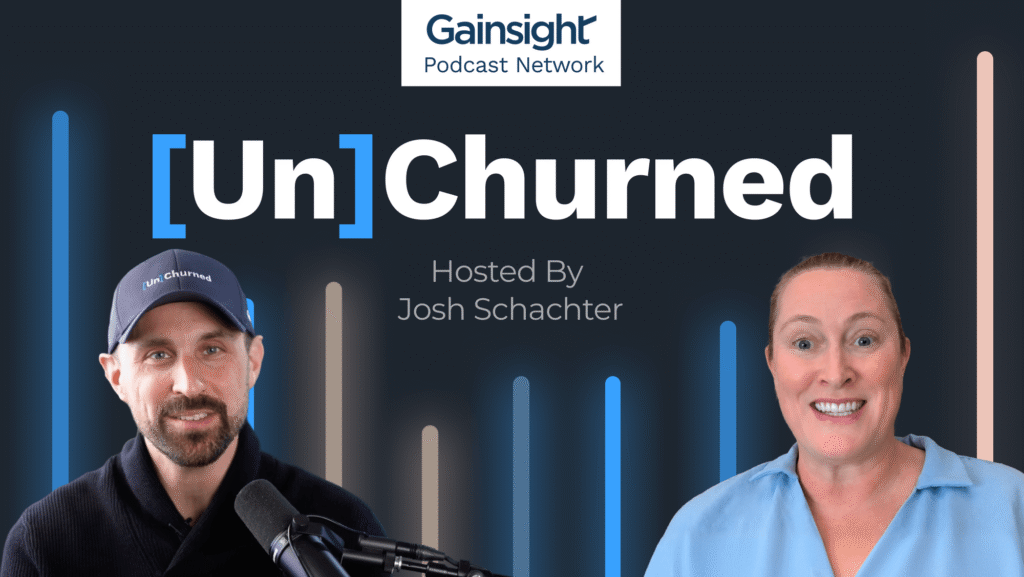
Unit4 CCO Jean de Villiers on running CS as a profit center, agentic digital CSMs, cutting mid-touch, and the Challenger Sale. Churn-killing tactics inside.

193. Why Unit4 Cut Mid-Touch and Bet on AI ft. Jean de Villiers
Show Notes
No one celebrates a new ERP. No champagne. Just groans.
Jean de Villiers, Chief Customer Officer at Unit4, wants to flip that script.
Jean shares they have kept customers for 20+ years in an industry built on dread. Secret? He runs customer success like a business, not a cost center. He cut the safe middle option. He’s betting big on AI agents. And he trains his whole team to have the uncomfortable conversations most people avoid.
In this episode of Unchurned, Jean sits down with host Josh Schachter to unpack the playbook: why 45% of what customers pay for goes unused, how high-touch service drives a 50-point gap in customer promotion, and what it really takes to make people love the software they’re supposed to hate.
What You’ll Learn
– Why Unit4 runs CS as a profit center, not a cost
– How to hit 30% contribution margin to EBITDA in post-sales
– Why Unit4 cut mid-touch and kept only high and digital
– Packaging every service into a self-serve catalog
– Building an agentic digital CSM that feels high-touch
– The 50-point NPS gap between high-touch and self-serve
– Why 45% consumption is ERP’s dirty secret
– Training non-sellers on the Challenger Sale method
– How AI plus human domain expertise wins together
—
Want the playbook, not just the conversation? Subscribe for deep-dive, actionable breakdowns from every episode at unchurned.substack.com.
—
Timestamps
0:00 – Preview and Introduction
1:44 – Meet Jean de Villiers
2:45 – What Unit4 does and its four verticals
4:32 – Customers who stay 20+ years
6:32 – The org structure of post-sales
7:32 – Running CS as a profit center under PE
8:50 – Why they cut mid-touch
9:45 – Packaging services into a catalog
12:20 – The agentic digital CSM vision
13:53 – Success For You: the high-touch subscription
18:12 – Sunsetting on-prem product, migrating to cloud & Ava
21:50 – The 45% consumption problem
23:57 – The 50-point NPS difference
25:30 – Challenger Sale training for everyone
31:40 – Wrap-up
Featuring

Josh Schachter, Host
SVP, Strategy & Market Development @ Gainsight

Jean de Villiers, Guest
CCO @ Unit4
Transcript
Jean de Villiers [00:00:00]:
The reality is about 45% is the number which is the level of consumption versus the subscription entitlement. That’s crazy. So, you know, you start at 45 on average, you have one bad support experience, you have a straw on the camel’s back and you have a bad PS experience. Same thing.
Bad education experience, bad account management experience, bad billing experience. Suddenly you got a whole bunch of straws in the camel’s back and one of them breaks the camel’s back. And then it’s billing was the problem. Oh, no, no.
Jean de Villiers [00:00:28]:
45% consumption was the problem. Everything else just added to it. Right? So again, our big hairy, aggressive goal is how do we max that consumption out?
Josh Schachter [Host] [00:00:38]:
You’re listening to Unchurned, brought to you by the Gainsight podcast network. Here’s a dirty secret about the ERP industry. Customers use less than half of what they pay for. Jean de Villiers is out to change that. As Chief Customer Officer At Unit 4, he runs everything after the sale for software. So trusted some customers stay for more than 20 years. His bet pair an agentic AI assistant with real human guidance and get customers to value faster than anyone thought possible. Today, how do you make people love enterprise software? I’m Josh Schachter.
Josh Schachter [Host] [00:01:12]:
This is Unchurned. Subscribe to our substack@ Unchurned.Gainsight.com where we go deep on every episode. Like how one post sales team at Cloudbeds built over 150 AI agents. That story and more at Unchurned.Gainsight.Com welcome everybody to this episode of Unturned. I’m your host, Josh Schachter, senior vice president of strategy and go to market development at Gainsight. I am here today. I’m very excited to be here today with Jean de Villiers. I almost.
Josh Schachter [Host] [00:01:48]:
What do you give me? Like 80%.
Jean de Villiers [00:01:49]:
It was awesome. It was awesome. Don’t worry about it.
Josh Schachter [Host] [00:01:52]:
My own hesitancy held me back on that one. My lack of confidence. Jean de Villier.
Jean de Villiers [00:01:59]:
Perfect.
Josh Schachter [Host] [00:02:01]:
Yes. By the way, you are French. I think. I mean, I know you live in
Jean de Villiers [00:02:06]:
England a long time back, so I’m South African. My ancestors were French. We kept the names less of the language, unfortunately. So my French is too okay.
Josh Schachter [Host] [00:02:18]:
Because when we first. Oh, by the way, he’s chief customer officer at Unit four. But when we first met a week ago prepping, I was like, oh, I was expecting like this just stereotypical Frenchman. And then. And then there you were. And I was like, the accent was more British than French. And despite the name and you live in England I was very confused. But regardless, we’re going to talk about post sales, not about romantic languages.
Josh Schachter [Host] [00:02:45]:
So you are the CCO at unit four?
Jean de Villiers [00:02:48]:
That’s right, yeah.
Josh Schachter [Host] [00:02:49]:
Tell us a little bit about Unit four. You know, particularly for the folks maybe in North America, you know, you guys are large brand globally, but especially so in Europe. And then let’s talk about how you run your org.
Jean de Villiers [00:03:01]:
Sure. So Unit 4 is SaaS based Enterprise Resource planning software, but focused on a very specific set of markets. So really focused on four kind of key industry verticals. Not for profits, local government, but not generally, you know, big central government agencies, typically small government agencies and municipalities, county councils, that sort of thing, professional services organizations. So you know, think accountants, think engineers, but not so much construction because that requires a whole other supply chain aspect which is just not where we focus. We really focus in on serving people who serve, in effect. Sure. And then of course higher education is another major component of that.
Jean de Villiers [00:03:52]:
So those are kind of the four verticals we focus in on. And my job is essentially to manage the customer’s experience post sale. So once they’ve committed to us, how do I essentially ensure that they don’t churn? Right. How do we make sure that they have a fantastic life cycle with us? And those life cycles can be long. We’ve got many customers that are over 20 years with unit four, which is different to other software. So it’s a really, really important piece to us. And maintaining our churn rate well above or our gross revenue retention rate well above 90% is a key focus.
Josh Schachter [Host] [00:04:32]:
20 years. You’ve got customers that have been with you for over 20 years?
Jean de Villiers [00:04:35]:
Absolutely, yeah, yeah, yeah. And they’ve been with us through multiple iterations of the software from its on premise beginnings. And this software was, was really invented in 1980. Right. So back in the green screen days through to today where it’s obviously SaaS and cloud software.
Josh Schachter [Host] [00:04:55]:
So what’s the through line there? If you had to encapsulate that all that’s kept such loyal customers.
Jean de Villiers [00:05:03]:
I think first off we focus in on the mid market. Right. So we don’t really play in the enterprise space. If we’re bumping up against our colleagues at SAP or Workday, we haven’t qualified particularly well. It’s rare that we bump up against them now we sometimes do in North America because those entities serve a lower degree of the marketplace in North America compared to other places. But generally in Europe, which is the majority of our base, we don’t intend to bump up against them. So because we’re mid market and because we’re focused on those four niches, we find that our customers have been able to really leverage the platform to be able to do really interesting things for them and it becomes incredibly sticky as a consequence. The original kind of value proposition was, you know, you can customize it like crazy, which is not a good idea in a SaaS context.
Jean de Villiers [00:06:02]:
So changing that motion and shifting out of customizing the core code or direct calls to the database, which is a terrible security nightmare, and shifting customers into an abstraction layer where they can still personalize it, but you’re not going to get it to run your intelligent home lighting system, which one customer actually did, which is quite an interesting use of ARP software.
Josh Schachter [Host] [00:06:26]:
But yeah, that’s for another time, I suppose. What’s the layout of your org running all post sales?
Jean de Villiers [00:06:36]:
So it’s effectively, if you think about kind of a customer life cycle, right from onboarding and adoption activity, through education, education through professional services, customer experience wrapped around it, which is traditionally what people call customer success, we call it experience wrapped around that journey. And we’ve done some fairly unique things which you alluded to there earlier, Josh, which I’m sure we’ll get into. And then of course looking at broadly the support life cycle and the break fix around that and making sure that our customers have a great link not only to get issues dealt with, but longer term defects managed within the software, it does happen occasionally and of course that’s gotta be managed effectively. So that flows through our support organization, through something we call Cloud Hub, into our cloud operations team.
Josh Schachter [Host] [00:07:30]:
So you just referenced it, so let’s go there. Tell me about how you manage the high touch, the mid touch, the digital touch. Right? The kind of quintessential segments of post sales through your CXCS motion.
Jean de Villiers [00:07:42]:
That’s great question, Josh. So you know we’re private equity owned and that has some implications. The first implication is cloud gross margin becomes an incredibly important metric because it’s a value creation metric. So fundamentally having traditional CS structures wrapped into cloud gross margin, it’s kind of a non starter for our owners. And what we’ve had to do is extract CS out of that operational expense, put it into a cost of sale line, which is essentially what I run and effectively run that as a profit center. So our owners expect us to return a 30% contribution margin to EBITDA and fundamentally that means we’ve got to run all those functions that I talked about at a reasonable level of profit in order to return that EBITDA element. But the other aspect to it then is if you’ve extracted cs, running a significant mid touch environment is cost heavy. And so we’ve taken a, you know, some say brave, some say tough decision to essentially have only a digital touch and a high touch motion.
Jean de Villiers [00:09:04]:
So we, we’ve, we’ve spent a lot of time and energy, you know, looking at what plagues ERP as, as a, as an industry, as, as a capability that we bring to market us and other players out there. And the key things that impact those, those customers is the sheer length of time it takes to get to any kind of value, the, the sheer duration of an onboarding, which is why they’re called implementations, because it’s not onboarding in a traditional SaaS context. Right. So our view was no, it should be onboarding. We need to get this done in 90 days. What are you talking about, two years? That’s insane. No, so we spent a lot of time and energy essentially packaging every single thing we do, whether it’s a professional services activity, an educational activity, a customer success management activity, and enterprise.
Josh Schachter [Host] [00:10:01]:
To be clear, there’s three, there’s 318 of these activities, right in your catalog, correct?
Jean de Villiers [00:10:07]:
Yeah. So we’ve packaged them all up into our service catalog. We don’t expect our customer to actually
Josh Schachter [Host] [00:10:13]:
send out like the catalog like at Christmas. Do you have like. I’m envisioning. You’ve got so many there. I’m envisioning like you literally have like a printing press that you’re sending out catalogs to people and you know. Yeah, yeah, yeah, yeah, yeah.
Jean de Villiers [00:10:26]:
No, we don’t, we don’t. What we do is we, at a digital level, we give our customers guidance on what we think they could leverage out of that catalog based on their consumption, based on their telemetry, based on what they’re doing and what their peers are doing across their vertical.
Josh Schachter [Host] [00:10:43]:
And this is the sellers that are giving that recommendation and guidance or we
Jean de Villiers [00:10:48]:
send it out through a digital success plan through Gainsight.
Josh Schachter [Host] [00:10:53]:
Okay.
Jean de Villiers [00:10:54]:
So it flows through Gainsight, out to the customer, through the customer portal, our community for you. And then ultimately the customer then can self serve on. Well, I’m kind of interested who, you know, can I know more. And when they click, I want to know more. We connect them with the services salesperson who will close that piece of work. They will buy effectively from the catalog, one of those service packages.
Josh Schachter [Host] [00:11:23]:
So even the guidance around it is really low. No touch.
Jean de Villiers [00:11:28]:
It’s extremely low touch. Now of course we have a digital success management team, but their job is really mass communication. Out to the marketplace and really trying to send out through those success plans meaningful information that a customer can make a decision on or a call on that says, actually there’s something I’ve got to think about here. My peers are doing this, I should have a look at this. And even if it’s that, even if it’s just a discussion, it creates that contact and that context. Right. Because the long tail in any SaaS business will tell you that they don’t hear much from their account manager. They may not hear much from a digital success or even a mid touch success management perspective.
Jean de Villiers [00:12:15]:
So we’ve trying to cure that through technology. The key that you know, in the area that we’re working very closely with gainsight on and we’re really challenging each other on is build me an agentic digital CSM so that our customer can have as much of a positive high touch experience with it through digital and AI mechanism as they do with a human. And that’s not to diminish our high touch service at all because I think it’s just different mission criticality for the customers that choose the high touch option. But ideally the objective is that the experience the customer has in terms of a really strong success plan that is not the usual motherhood and apple pie nonsense or support ticket reference chasing kind of success plans that you typically see to something that challenges the customer that says, hey, we can see that you’re not using a significant component of your subscription, you have this entitlement, you’re not using it. This is what your peers are doing with it. Would you like to know more? That’s challenging. I might be interested in responding to something like that.
Josh Schachter [Host] [00:13:32]:
Yeah. It has to be contextual, it has to be, it has to make sense for you feel personalized.
Jean de Villiers [00:13:37]:
Right on. Yeah, yeah, yeah. So you know, we’re not at end of job on that by any means. I think we’re constantly learning, we’re constantly evolving it. I think we’re getting better and better at it. But that’s really the focus for the long tail is that agentic digital engagement with the high touch engagement that is effectively sold through what we call. So everything we do is called success for you. Right? We tag a little for you on the end of everything.
Jean de Villiers [00:14:03]:
It’s kind of our thing. But success for you is essentially both the methodology as well as the framework of engagement. Right. So it contains all of those service packages. You can pay cash, you can self serve. If this thing’s not mission critical for you, no problem. If it is and you want much more human interaction with the organization then SuccessView Professional is the subscription we propose to our customers. We co term that with the software subscription and essentially it’s a wrapper that ensures adoption.
Jean de Villiers [00:14:36]:
And the whole focus of our CSMs is I’ve looked at your telemetry, I understand what you’re not using. This is how we can switch it on. Here’s a package that does that and as part of that subscription our customers essentially get access to the csm. They get access to a technical account manager paired up with a csm. So you got a really strong technical understanding of the software. But they also at the same time have a set of points that they can spend on anything in the catalog and the CSM will guide them to the packages that they should spend points on in order to get value out of their subscription. And that’s been the big evolution that we’ve driven over the last three years and it’s going gangbusters at the moment. Where you know, we’re well over.
Jean de Villiers [00:15:26]:
We kicked it off formally just on two years ago. We relaunched again in January with a much more simplified model, more services, more capability, better pricing point for our mid market customers. And we’ve got around 15% of the total install base on this subscription. High touch subscription at the moment where we’re pitching it, we’re getting a massive take rate. It’s well over 75, 80% where it’s being pitched. We’re really working with our sales organization to help them to understand how to pitch the value. And what we can see is towards the back end of this year we will at least double the level of subscriptions we have compared to where we are today at just about the end of Q2.
Josh Schachter [Host] [00:16:19]:
So, so you get, so I’m doing a little numbers in my mind here. So you’re, you’re, you’re getting about an 80%, 75, 80% take rate on when you do pitch it and Overall it’s about 15% of your customers. So yeah, so you’re pitching it about 20% of the time. One on every account, five accounts effectively.
Jean de Villiers [00:16:35]:
Absolutely. And that’s the thing we’re looking to accelerate now listen, of course we have a significant partner community and this can be scary for partners, right, because it can feel like it’s cannibalizing their value proposition. So in effect we’re working with our partners to define a flavor of success for you that they would actually execute. So in other words, they use our ip, they use our method, they become us to all intents and purposes. But it’s, they retain the revenue, they retain the engagement and the relationship with the customer and that’s exciting. So I think, you know, my big hairy, aggressive goal is I’d like to see a situation where, you know, 60 to 70% of our base use this high touch capability, whether it’s through us or whether it’s through our partners. Non material to me, I just want to see customers wrapped around because, you know, When I joined Unit 4 just on over three years ago, every time I spoke to customers I would hear similar sort of stories. I don’t know where your software is going.
Jean de Villiers [00:17:46]:
I haven’t seen an update for a while, haven’t spoken to anyone for a while. You seem to come around when it’s time to renew. You know, this is not how you build churn risk management, this is how you create churn. And so, you know, there’s been a huge focus on what can we do within customer success broadly across all of those four functions to just change that
Josh Schachter [Host] [00:18:11]:
game completely within that 15% current install base that’s leveraging those services. Can you say anything about the outcomes and impact that it’s had? I mean I know there’s different, there’s a myriad of different packages, but what can you say about the outcomes?
Jean de Villiers [00:18:27]:
Well, two things. So in October 2023 we took a tough decision. We could see the AI train coming and we have to embed AI in our technology. It’s a no brainer. It’s something that will materially enable the life of the chief financial office or the header, you know, practice leader of services or the partner that is running your service, practice, whatever it might be, head of HR and so on. We could see that train coming and we knew that unless our customers were in the cloud, there was no possible way to deliver the innovation to them. So we made the call to sunset our on premise product. And that’s a product that’s been around 40 years, right? So very, very successful on premise products.
Jean de Villiers [00:19:20]:
And we gave our customers notice in 23, started at the beginning of 24 and December 31, 26 on prem is completely sunset. Now of course there are certain customers that, you know, highly secretive agencies, that’s all I’ll say, who can’t ever be in the cloud. And we have solutions for them in contained environments but they’re running the cloud code base which is the key thing and they’re operating it as if it’s SaaS, so call it sassish in effect. And so to do that we really had to think very clearly around how do we rapidly migrate those customers to the cloud at scale? It’s not something that could span out over many years. And I’m pleased to tell you we’ve pretty much concluded just about all of the commercial discussions around those migrations. We’re about 50% of the way through. We’ve migrated over half of our customer base already. We’ve built a phenomenal cloud migration engine that is driving all of those things that gets us to, in effect, you know, a, an outcome where we can start bringing AI into the picture more extensively for our customers.
Jean de Villiers [00:20:39]:
And we’re releasing through ava, our advanced virtual assistant.
Josh Schachter [Host] [00:20:45]:
Everybody’s virtual assistant is called Ava. Sorry, I don’t mean to.
Jean de Villiers [00:20:50]:
I know, I hear you loud and clear. I don’t run marketing. The assistant, though, is, you know, we’re taking an interesting approach to it, and perhaps that’s a conversation for another time, Josh. But suffice to say, our customers typically will have an IT team of sort of 10 people. So to just give them a big agentic toolkit and say knock yourself out is not going to happen. They would struggle with that situation. So what we’re doing is taking the opposite approach where we just build the agents in and we start to deploy them through every release cycle and create more and more capability. So that means in effect, that our customers will have more and more capability at their disposal.
Jean de Villiers [00:21:39]:
But unless you’ve got a constant engagement with them to help them to understand the art of the possible, it will not get consumed. And if you look across erp, generally across the industry, and it’s a terrible dirty secret, but the reality is about 45% is the number which is the level of consumption versus the subscription entitlement. That’s crazy. So, you know, you start at 45 on average, you have one bad support experience, you have a straw on the camel’s back and you have a bad PS experience. Same thing. Bad education experience, bad account management experience, bad billing experience, suddenly you got a whole bunch of straws in the camel’s back and one of them breaks the camel’s back. And then it’s billing was the problem. Oh no, no.
Jean de Villiers [00:22:32]:
45% consumption was the problem. Everything else just added to it. Right. So again, our big hairy, aggressive goal is how do we max that consumption out? And that’s why we focus in on success for you professional wrapped around particularly the onboarding and the switching on of these new AI capabilities that we’re rolling out every quarter.
Josh Schachter [Host] [00:22:56]:
Are there any for if you can share anything, I mean, any success metrics around how this has been transform for you with the services versus before what
Jean de Villiers [00:23:07]:
I would say, I think it’s early days for most vendors in the AI space. But what I can tell you is I had a great conversation with a CFO in Finland the other day where they were saying, I love Ava, I want more Ava. How quickly can you get her to me? She’s anthropomorphized Ava to her C, but fundamentally it’s changing her life and she gave a whole bunch of anecdotal reasons for that in terms of never having to log into the ERP to be able to do approval. She’s doing it through teams, which is a collaboration channel. You could equally do it through Slack and you know, things like this. The other metric that I would offer is when we look at those customers that are on our professional. So the high touch engagement model versus the self serve model, there is about a 50 point difference in net promotion.
Josh Schachter [Host] [00:24:13]:
Wow.
Jean de Villiers [00:24:14]:
And it’s kind of a no brainer, right? Yeah. I can self serve if I want to, but I’m not hearing from anyone at a human touch level. When I am hearing from someone at a human touch level and I’m being led on a journey and I’m being challenged and I’m being given great advice and guess what? I’m being promoted because I’ve demonstrated value realization, then net promotion just improves radically. Right. So that’s kind of the big area aggressive goal.
Josh Schachter [Host] [00:24:45]:
50 points. NPS is a profound delta, by the way.
Jean de Villiers [00:24:48]:
That’s a monster of Alto. It’s huge. It’s huge. Now listen, ERP typically sits in the range of 0 to plus 15. No one loves their ERP. Right. It’s just, it’s one of those things. And, and also no one, no board celebrates a new ERP onboarding.
Jean de Villiers [00:25:04]:
It’s, it’s just not a no. CHAMPAGNE CORKS POP that is generally just groans and dismay now. And that’s because it’s been really painful and the perception of value realization has been low for many, many boards. So to be able to change that dynamic is, is really our, our mission.
Josh Schachter [Host] [00:25:22]:
That’s. Yeah. Congratulations on that. That’s a wonderful win for your team. The last thing I want to touch on with you today is to talk about how you’re training your post sales team. Tell us a little bit about the concept of the Challenger sale. Most folks are familiar with it, but maybe some are not yet and what that means, the impact that it’s having and you hope to have with that and how you are training and enabling Your team around it.
Jean de Villiers [00:25:51]:
Sure. So there are two models to selling service within a SaaS business. More often than not, that sales team sits within the service. Sales team sits within customer success or professional services or whatever you want to call it. The go to market team is typically focused solely on software. In my experience and based on previous roles, we have shifted all of our sales motion into the go to market team and we quota retire and we compensate pretty equally in terms of software versus service. And that’s a tough balance to find, but it’s an important one because it drives behavior. And the consequence of that is that we see a go to market team that is quite engaged with the customer.
Jean de Villiers [00:26:41]:
They really understand in depth their needs, their pain, what they’re trying to solve for them and they start starting more and more to understand the service packages that will assist with that. Right. Fantastic. And most SaaS businesses spend a lot of time and energy equipping, enabling and developing go to market teams. Where they often fall short is they sort of expect CSMs to be able to do this naturally and the practical reality is where they’re going to learn it. They don’t do it naturally. Right. So we have spent a lot of energy putting together Challenger Sale training.
Jean de Villiers [00:27:20]:
So the Challenger Sale is a sales method and it’s predicated on having an honest conversation with your customer about their pain and, and how you can solve it. And that can be a challenging conversation because sometimes you’re introducing things to your customer that are uncomfortable and that they don’t necessarily want to admit or talk about. And the ability with the Challenger Sale method is you can break through to that and demonstrate real partnership and thought, leadership and value to your customer by driving that. So we’ve based a bunch of education around that model and that method and we are rolling it out to not only our CSMs, but to our project managers, to our architects, to our senior consultants, to the team in our factories. Don’t think Victorian monstrosities, think more like a Tesla factory. Beautiful ballet of machines that drive our cloud migrations and the migration activities, managed services activities that we do, all of those team members will essentially be trained in the Challenger Sale, not because I want them to sell, but because if, if you’re talking to a customer about their lack of consumption or a piece of the technology that they’re not delighted with and you’re trying to take them on the path that says, hey, there’s a better way to do this. Here’s what it looks like. You can’t do that through lunches and relationships you can’t do that through stuttering and not being sure of yourself.
Jean de Villiers [00:28:49]:
You have to be confident. You have to be able to pitch and sell an idea. You don’t have to attach commercials to it. There’s a tiny percent of humans that can do that. They’re called sales teams. Most people cannot. But what they can do is pitch and sell the idea of what they’d like to do to help. And that’s really what we’ve wrapped kind of this challenger sale concept around.
Josh Schachter [Host] [00:29:14]:
What was the catalyst for you to bring training in for this? Is this something that you’ve witnessed before in past orgs?
Jean de Villiers [00:29:21]:
Yeah, look, it’s, it’s. I’m a recovering management consultant. I apologize. And I think, you know, I’ve just seen a lot of organizations where great guidance can get lost very quickly in the noise either and more often than not, internal guidance. Right. The ability of internal individuals within an organization who truly understand the issues and truly understand the environment. Their ability to get the message across to leaders and to peers, you know, as to what’s wrong and how they can fix it and what, you know, what, what could be or what’s right and how they could capitalize on it. Right, yeah.
Jean de Villiers [00:30:03]:
And so I think just learning from that over the number of years that I’ve been doing this sort of thing, um, it, it just, and I’ve used the challenge of sale in a previous life. It just was a no brainer that. I think if you can just give everyone that confidence to have a, a really great conversation with your customer that takes them on a very positive journey that will deliver value and you can get them convinced that they should do this. You don’t have to commercialize that. But if you can just have that conversation, you do become a trusted partner. The term trusted advisor is kind of overused and it’s a bit redundant in the modern world because Claude and co pilots are the trusted advisors these days. But I think you can become a thought leader that can give them insight onto where their journey should go. And I think that’s super important.
Josh Schachter [Host] [00:30:58]:
I agree. Yeah. And you have the pattern recognition. You’re working with all the different types of companies. You can benchmark them again. So yeah, yeah, Claude and Gemini and ChatGPT, those are our advisors. But there’s still room for domain center of excellence. Like what you guys.
Jean de Villiers [00:31:13]:
Exactly right. Exactly right. And you know, and I think given that we’re really focused on those four core verticals, that is what we can bring to the table is that domain expertise that. Yes, the LLMs have got phenomenal insight and intel, but you have to understand the question to ask the LLM to get at it. And sometimes just that combination of the LLM and the human creates a fantastic symbiosis.
Josh Schachter [Host] [00:31:41]:
Well, three things that I love about the way you’re running your work at Unit four. You are investing in all the right things. You’re, you’re thinking ahead about the agentic future of the csm. The agentic csm. Love that you’re, you’re, you’re leaning in on that even farther along than what I see many other leaders in the space. You’re investing in the human side as well, the training and the Challenger sale. And not even for the sake of the commercials, but for the sake of just being able to speak to and with customers and prospects better and have those articulate conversations and understand what their needs are. It’s very first principles and that’s very important, especially in this agentic world where agentic will be the enabler, the amplification of the outcome of those conversations.
Josh Schachter [Host] [00:32:26]:
And then I mean, who can argue with 30 points EBITDA on the business that you’re running? Congratulations, that’s wonderful.
Jean de Villiers [00:32:33]:
Makes board happy.
Josh Schachter [Host] [00:32:35]:
You know, happy wife, happy life. There’s probably some phrase around happy board, happy whatever, retirement. Yes, exactly, exactly. John JDV. So I don’t embarrass my pronunciation again. Thank you, CCO of Unit 4. Thank you so much for being on the program. Wishing you a wonderful rest of the year.
Jean de Villiers [00:32:56]:
Thank you so much, Josh. Great to talk to you.
[Un]Churned is the no. 1 podcast for customer retention. Hosted by Josh Schachter, each episode dives into post-sales strategy and how to lead in the agentic era.
Browse Series
Subscribe on